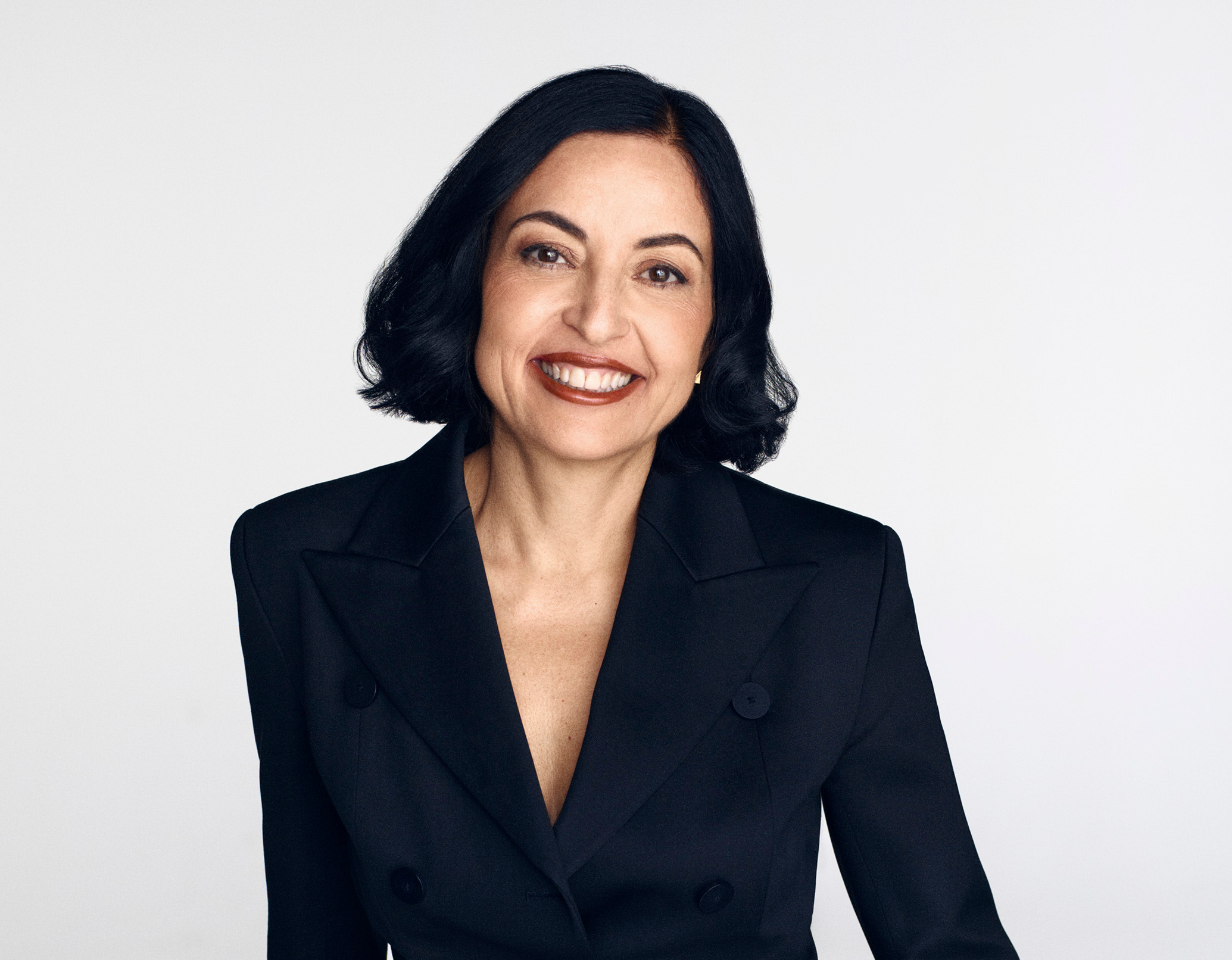


When Juti meets male politicians in her work, she believes there’s one myth that has to be debunked.
— They tell me, ‘My wife uses your products.’ And I say, ‘Really? You didn’t have a shower?’ Beauty is part of the human adventure. The day we are born and the day we die, we have a bath. Every morning and every evening, we all do beauty rituals. Every important moment of our lives, we look at beauty. It’s intimately linked to the human adventure. It’s a personal thing and about looking after yourself. The moment you stop looking after yourself, you also distance yourself from society. So, it’s actually deeply social. When you look after yourself, and you think about how you’re gonna do your hair, you’re thinking, ‘How am I going to express myself to the others? A sense of belonging? Try to show I’m different, or modern? What does my look say about me?’ It’s both a very important means of self-expression and deeply social. And, if one thing, it plays a big part in our lives.
Two billion people in the world, she continues, have skin diseases. People with acne or eczema very often also have mental health problems, since they isolate themselves or hardly sleep when it’s too itchy.
— Skin is very reflective of and important to your health. The other thing I would like European politicians to understand is that beauty is a very important socioeconomic contributor. If you look at Europe, the beauty industry — not just L’Oréal — contributes to 2.5 million jobs. Beauty starts in agriculture. You need essential oils and ingredients, and it goes all the way to salons, pharmacies, and dermatologists. It has a very big impact. In France, there are more salons than boulangeries. I wouldn’t be surprised if it’s similar in the Nordics. It’s part of a ritual and social life.
How have you implemented new technologies?
— The interesting thing is that in the old search engines, you asked, ‘I need X.’ With ChatGPT, when it came a few years ago, we thought that people would spend less time, since you would get the information you want immediately, which is true. But instead, it creates conversations. Now, consumers spend a lot more time chatting. It can be 11 minutes per search because it generates new stuff and new ways to communicate.
— For consumer journeys, you can use technology to make your operations all the more efficient. You can make science faster. You can go much deeper in the science and predict and diagnose much better.
— Then you can use it with your employees to make their lives easier. We have 90,000 employees. 73,000 have been trained in AI. We are moving really fast to make our lives simpler.
When you say that the beauty industry is heading into ‘a new renaissance,’ what do you mean?
— I’m an anthropologist. I was thinking about the Renaissance the other day, and I thought that I do believe in a new Renaissance. The reason for that is that both the Renaissance and today are moments of huge technological disruption. In the Renaissance, you had the first oil paintings; people understood the world was not flat, and that the Earth was not the centre of the universe. Just look at Leonardo’s drawings of flying planes; there was a huge explosion of technological development. There was also a huge love for and explosion of beauty. There’s a very good book called The Renaissance Woman that looks at how women already then were making ointments to have less birthmarks. It was a period where beauty really was centre stage.
— There was both technology and beauty. The mirror was one of the things that made beauty more accessible to people, just like I think the mobile phone does because now we see ourselves all day on camera. Then, we want to look after our looks as well. The Renaissance was very visual, and yet again, we have a very visual period.
How can brands take advantage of this new renaissance?
— I think we have, especially since beauty is so visual. If you look at social media, beauty is the number one conversation, together with fashion. It’s self-expression and highly visual. So we take advantage of it. Beauty is also, and has always been, highly cultural. In every period of history, beauty can signal a transition. When the pill arrived, women cut their hair, or they did more makeup. During the pandemic, we went more into cocooning, using candles, and looking after our skin. The moment the pandemic ended, we saw a boom followed by a colour and fragrance explosion.
— Now, with GLPs, which have an impact on skin, we’ve developed a lot of products to deal with the Ozempic face, but also with Ozempic hair. The hair falls out, so we have a lot of products that help with hair loss. What I also learned recently is that one of the reasons for the explosion of various supplements and fragrances with a lot of fruity, almost gastronomic, scents is that, because people eat less, they want to spray those sweet scents as their dessert. Beauty is culture, and it moves with culture. It moves with society. It’s just part of it. That’s why it’s essential. That’s why it’s not superficial. It’s the contrary of superficial.
Aiming to be at the forefront of technology and science, L’Oréal obviously aims to play a big part in the AI race and everything that changes with it.
— But we’ll do so in an intentional manner with clear principles of what we do and what we don’t do. That’s very important; beauty is essentially about humans. So, we follow ethical principles. We also follow environmental principles. And we know that AI has a huge footprint. So, for instance, when we create marketing campaigns, our marketers now have a tool enabled by AI which allows them to measure their footprint and helps them to limit the use of technology. It’s a great tool to use it wisely. It can help us accelerate our science and go deeper, more personalised. But it needs to be managed with care.
How big of a revolution is this for L’Oréal?
— We are undergoing a massive transformation. We are very used to it, but we do have to move really fast.
— I joined L’Oréal five years ago, almost six, and I tried to look at the development of the company, and I couldn’t find any bad years.
— By the way, beauty almost never has a bad year. Beauty tends to outgrow GDP, which is another reason why it shows you that it’s not superficial, but essential. We need it. In the Second World War, Winston Churchill didn’t ration lipsticks. He saw it as a sign of defiance. Beauty matters in good and in bad times. It’s always important.
You’ve unveiled a new collaboration with OpenAI. Can you say that it provides a quite unique opportunity for you to stay very close to your end consumer through that chat field?
— Yes, LLMs can help us to have better beauty conversations because we might be able to go more in depth. As mentioned, we are quite amazed by it. We thought at the beginning that with LLMs, the search would be really fast, but it’s now 11 minutes longer because people want to converse. It changes the way you communicate, and you have to adapt to that. I think LLMs will continue to evolve and show us a lot of things. But in the end, they’re an incredible technology. They’re like a super IQ. They’re incredible analytical tools. But they’re not human.
— You have to remain human, and I think that’s very important. Even though we think they have emotions, they don’t. They don’t have breakups, they don’t fall in love, and they don’t have EQ. That remains on the human side. So, we have to work with and learn from them, of course, but also remember that in the end, it’s about human connections.
11 minutes. It’s not so often that you get that together with an end consumer.
— No. But a lot of young women and young men know enormously about beauty. Things I didn’t know at their age. And frankly, things professionals didn’t know. The access to knowledge is so high, and they’re learning it from other consumers on social media. So, you don’t only have one way of learning or one way of communicating. We have multiple ways, and, in the end, you still need to connect on the human level.
If you were to pick one next big product, what would that be?
— Tough one. There are a lot of products, and our pace of innovation is accelerating so much that we have a lot more launches than we’ve previously had.
— As we learn that the deeper interconnections there are between health and skin, and that everything is connected, I think there will be a lot of things we will discover. But products are not just about the body; they can also be trends created from the outside. Suddenly, there’s a need for colour. So, it’s very difficult to predict. That’s why you just have to have your antennas up.
— We now have a mapping project. It’s an act for dermatology, because there are very few dermatologists in the world. So we are mapping skin types all over the world. We’ve always done it, but we are now doing a very extensive mapping. We are really trying to bring more to diverse skin types. For us, diversity is not a slogan. It’s the business. We want to cater to every person on Earth, Juti concludes.
Top picture: Paul Schmidt
Related Stories