


With over 2.5 million new listings analysed daily across 191 countries, Bencha has quietly become one of the most data-rich platforms in the circular fashion industry. In their newly released resale report, the Stockholm-based company presents a comprehensive look at the global secondhand market, from brand rankings and consumer patterns to regional performance and policy impact.
We sat down with Amanda Thorén, CEO and founder of Bencha, to understand why Swedish brands like Acne Studios, Totême, and Fjällräven are winning internationally, how brands can unlock the value of resale data, and why fashion’s circular transition is already well underway, with or without the industry’s permission.
What motivated you to create this report, and what do you hope the industry takes away from it?
– We created this report because there’s a clear gap in the market when it comes to actionable, data-driven insight on resale and circular fashion. Too often, conversations around circularity stay theoretical, focused on what could happen rather than what is happening or what needs to come next. We aimed to cut through the noise and offer something concrete: real numbers, real trends, and a clearer sense of direction. We hope this report gives the industry insight and confidence to move from talk to action.
Your data shows that brands like Totême, Acne Studios, and Fjällräven are globally in demand. What do these brands have in common that makes them successful on the second-hand market?
– What stands out about these brands is how they’ve built long-term value through strong brand identity and product quality. Whether through premium fashion or functional design, they’ve created desirable products beyond the first purchase. In our analysis of 100+ Swedish brands on international resale platforms, these three consistently rank as top performers. It’s clear that investing in brand equity and product longevity pays off, not just on the first sale, but across the entire lifecycle.
One of your key findings is that consumer behaviour and policy drive the resale market more than producers. What implications does this have for how brands should operate going forward?
– This tells us the resale shift is happening, with or without brands’ active involvement. Consumers are already buying and selling secondhand, legislation is tightening, and the resale market is growing three to four times faster than traditional retail. Brands that want to stay relevant must stop seeing circularity as a cost or compliance issue and treat it as a real business opportunity. Many consumers are already engaging with brands on secondhand platforms – you might not have visibility into them yet. That’s a huge missed opportunity. By embracing resale, brands can regain control over their product lifecycle, strengthen customer relationships, and unlock new revenue streams beyond the initial sale.
Bencha tracks over 2.5 million new listings daily across 191 countries. What surprised you when looking at the global data in this report?
– What really surprised me was how well secondhand fashion is doing in smaller markets once you adjust for economic size. Countries like Sweden and Belgium punch far above their weight in resale activity relative to GDP and consumer engagement. This challenges the idea that resale is just a trend in the biggest or most fashion-forward markets. It shows that circular fashion can thrive anywhere with the right infrastructure and culture.
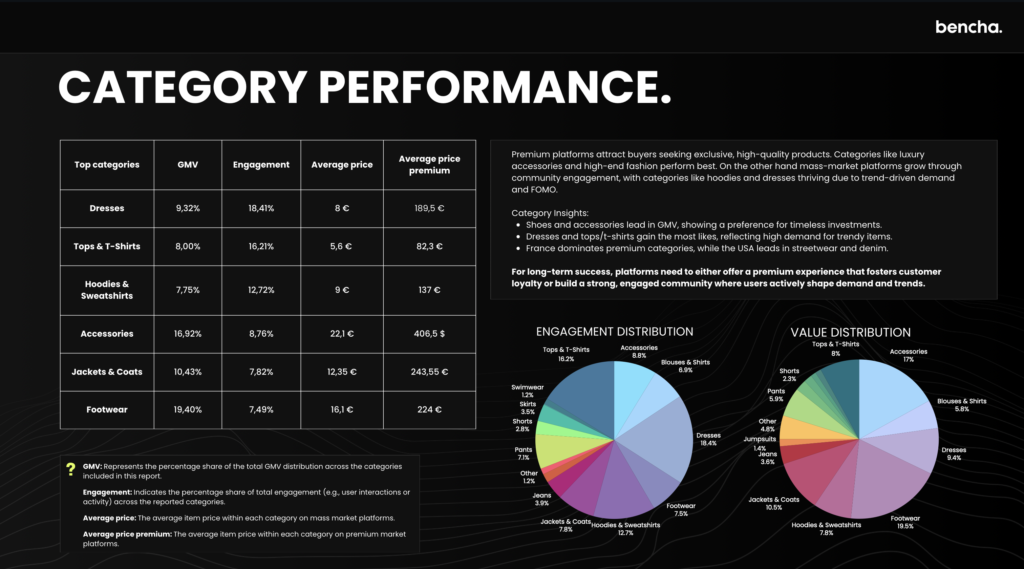
– Another insight is that growth isn’t only driven by luxury. Mass-market items like hoodies, dresses, and tops generate the most engagement, especially on community-driven platforms. This highlights how everyday, trend-led fashion is a major driver of resale, not just exclusive pieces.
You mention that 10 European countries account for over 60% of second-hand fashion volume. Which markets lead the charge, and why have they pulled ahead?
– Europe’s resale market is led by countries like France, the UK, and Germany. They’ve pulled ahead thanks to strong consumer demand, established resale platforms, and supportive policies. There’s a real cultural acceptance of secondhand fashion in these markets, which fuels both online and offline engagement. Meanwhile, emerging markets like Sweden, Belgium, and Poland are growing fast and closing the gap. They’re developing their own resale ecosystems and have strong potential to become key players as the circular economy expands across Europe.
How can brands and retailers practically use the insights from this report? Can it influence pricing, product development, or more?
– Absolutely. This report doesn’t just show resale trends—it offers actionable insights that brands, retailers, marketplaces, and service providers can act on. For instance, businesses can refine pricing strategies and design products that retain value longer by identifying top-performing categories like shoes and accessories in markets such as France, the UK, and Sweden. Consumer patterns show younger generations driving demand for sustainable, circular options, shaping which products succeed secondhand.
– There’s a strong omnichannel element too. While two-thirds of resale happens online, physical stores still play a key role. Understanding where resale is growing helps businesses align strategies with how people actually shop. For those who want to dig deeper, we offer customized insights through our tool, enabling brands to benchmark against competitors, track resale performance, and spot growth opportunities. It’s an exciting, fast-moving space. With so much momentum behind circular fashion and recommerce, it’ll be fascinating to see how the market evolves in the coming years.
You’re involved in research collaborations with the Swedish School of Textiles and Wargön Innovation. How does academic research support your commercial mission?
– We’re proud to collaborate with the Swedish School of Textiles and Wargön Innovation. These partnerships allow us to explore new ideas and innovations through structured, research-driven approaches. Working with academics helps us test concepts, validate with real data, and build stronger foundations for market-ready solutions.
What role do you think real-time data and pricing tools will play in shaping the future of circular fashion?
– Real-time data and pricing tools are essential for the future of circular fashion. One of resale’s biggest challenges is understanding actual market demand: what sells, at what price, and in what condition. Without this insight, businesses rely on guesswork or gut feeling, which is costly and risky. Better pricing tools enable brands to optimise for resale value from the design stage, building durable, repairable, and desirable products across multiple ownership cycles. This supports smarter take-back and recommerce strategies, helping businesses decide which items to recirculate and when.
Finally, what’s next for Bencha?
– One of the most exciting projects right now is Bencha Lens, which is a real-time identification technology that can scan multiple secondhand items simultaneously, capturing attributes and pricing in milliseconds. It’s a game-changer for efficiently scaling secondhand operations.


