

Florence Rousson, Show Director, opened the new edition of Première Vision well aware of several needs for the market and its key players.
— There is a huge transformation of the sector, making shows and B2B events key moments to find inspiration, new suppliers, and meet other companies that have the same problems, she says.
How would you describe this industry transformation in your own words?
— I think that there are two different crises. One of them is the sector and the market, and the other is more structural.
— Companies have to invent new business models, new ways to collaborate, and develop their business with their customers. It’s not so easy at the moment, because there is a crash in the ready-to-wear consumption. However, when you have such a crisis period, it’s also a good time for innovation.
— All the companies are looking for key solutions today. Some answers can be to produce with eco-responsibility, as well as making a lot of investment in data to perfectly know your customer and target your communication to them.
For a fabric fair like Première Vision, Rousson continues, it can also be about targeting new markets.
— Last edition, and for this edition again, we’ve introduced a new approach to the beauty market. I think that designers and brands are looking for new opportunities in new markets to convince the consumer to re-establish an attachment to the brand. We’re now also looking for a strong partnership with a key player in the beauty market that knows the sector very well. You will probably discover a new, more global offer on our September show in Paris with more producers of cosmetics and beauty products.
Being a global player, in the times we’re in, are certain markets more optimistic than others?
— You do have different levels of consumption. There is a lot of interest in the Saudi market, as well as the African and the South American markets. This crisis also opens opportunities for the development of new territories with a high capacity for investment, and perhaps more government support.
What other big topics are setting the tone for the event?
— The main problem today remains the (low) consumption, which is real all over the world. We’ll see how things will move and how the market and sector will reinvent themselves. It’s not so easy for the companies and exhibitors that are here to have a clear vision of the level of orders, making it difficult to plan and organise their production and make the right investment. Having a short-term vision is not so easy in a market where you work with a very long-term vision. This calls for brand new ways to think, to organise, and to plan.
But you remain optimistic?
— Always, Rousson concludes.
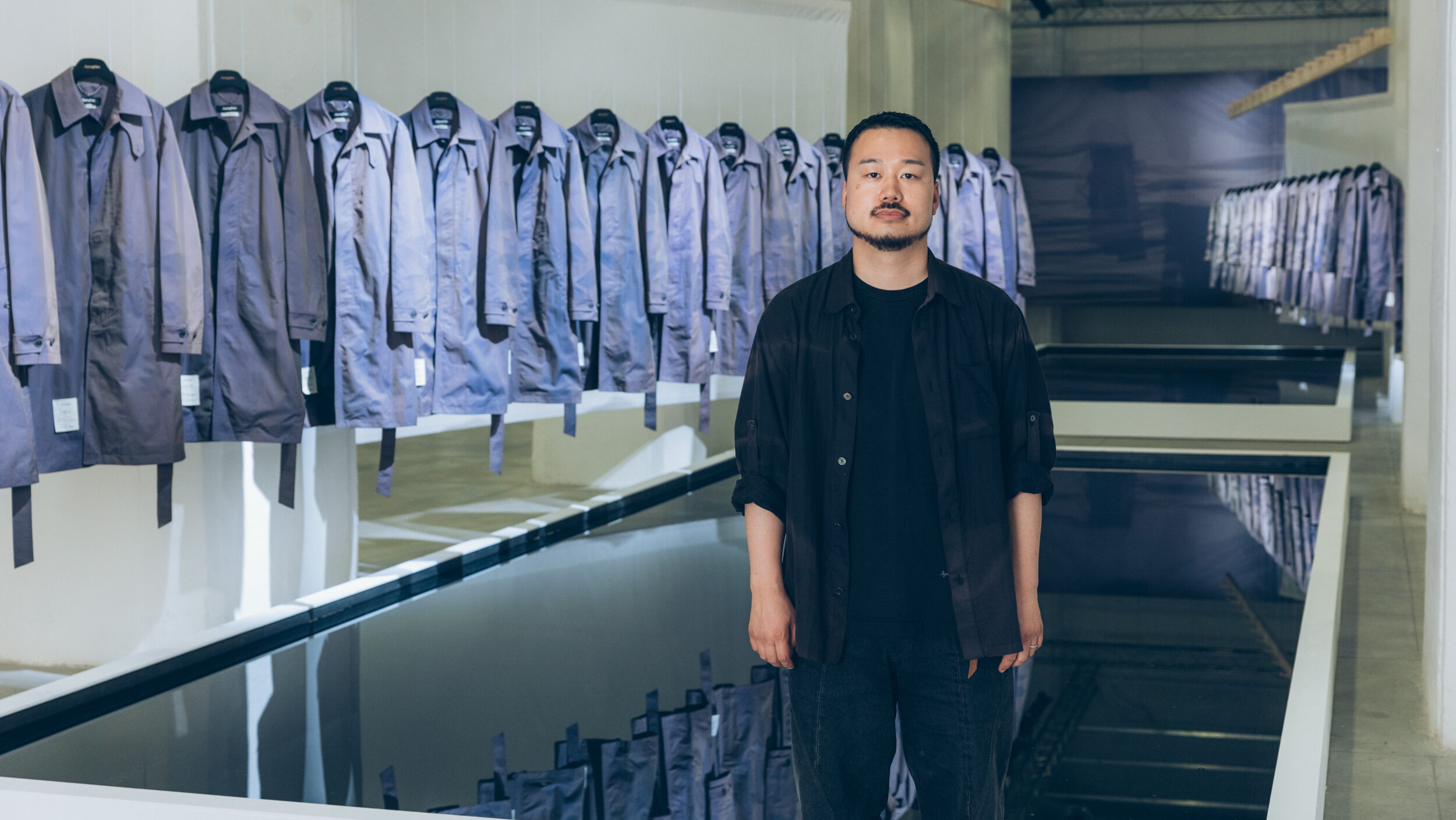
Première Vision exhibitor Nilörn has transformed from a branding and design company to having a holistic view from both a sustainability and compliance perspective for its clients.
— We are still in the labelling business, Group Sales and Marketing Manager Fredrik Clason explains, but now, it’s a broad landscape which is extremely challenging for our clients to navigate.
Besides functionality, what are they looking for now when turning to you? To comply with upcoming, complex EU regulations?
— Yes, the main topic for the last three to four years has been the Digital Product Passports and the overall legislation. That’s been like a tsunami for all our clients; how to follow and keep track of what’s going on has become a part of our job.
— When I’m talking to clients, I tell them that they need to listen and watch out for what’s going on, but also to be pragmatic in what’s coming. There is a big risk that they see that it’s a bigger challenge than it might be in the future. I tell them to stay a little calm.
For Nilörn, Clason continues, AI can create market business opportunities, but also challenges.
— I see great opportunities for how we can help clients, create ideas, and show innovation at a totally different speed than before, as well as create efficiency internally. One challenge is that there might be competitors who understand better what’s going on with AI, so that we lose market share.
Another transformative shift is how the needle has turned, where many of Nilörn’s clients have gone from having production in the Far East to now going back to local production.
— It kicked off during the pandemic, when we saw broken supply chains and the freight costs grew rapidly, Clason shares. They also want local production because it seems to be a more sustainable solution. And sometimes it is, but definitely not all the time. Efficiency is well connected to sustainability in many senses. They need to have a holistic perspective on it and be pragmatic. Where do they have production? What materials are available?
In your range, you also offer RFID, NFC, and digital twins. Are the clients looking for new innovations as before, or are they more conventional now?
— If you go back 10-15 years, everyone was greenwashing a little bit, while today, they’re more pragmatic. Clients are, of course, in innovation all the time, but they also know how difficult it is to innovate and to be ahead in innovation — also from a brand perspective — to have something within labelling that is so different to anyone else.
— To me, it’s more about securing the quality, where RFID, QR codes, and NFC come into play. Digital solutions are helping them with logistics and sharing information, which is also where we have seen the most progress and interest in recent years. Most of it, I think, is because of the Digital Product Passports and the legal part that has been coming like a tsunami.
— There’s also a push from distributors and retailers like Zalando demanding that brands which want to sell there need to have RFID, since it helps in their logistics. We’re now also talking about how QR codes will be a part of RFID: to scan them with a mobile device to get consumer information through an RFID, which you can do more or less today. That, I think, is the future.

According to Julieta Mercerat, Fashion & Trend Expert, Première Vision, the trade show put natural materials in a new light.
— Wool and cotton have been there for a while, but we are rediscovering them in new kinds of uses and ways of wearing them. Especially wool is a fibre that has been truly rediscovered; the sportswear sector is including it, aiming to get the natural waxes, the natural stretch, and other properties of a natural fibre and boost them. You of course need to adapt the fibre for sportswear, but natural materials with performance overall is a nice link to keep exploring.
What else do you look at now?
— Chemical recycling is a very promising thing. It’s still very niche, but it’s giving the chance to get really high-quality recycled materials. We have mechanical recycling, which is okay, but not a long-term solution. The quality of the fibres that we get after mechanical recycling is way less than that of new ones, so it still has limits.
It seems like it has been more in a lab scale state, but is now growing.
— Yes. We need to wait a little bit, but it will come, I hope. And then, the cellulosic fibres are also interesting. They are very easy, people like them, they’re soft, comfortable, can also be shiny sometimes, creating a really nice look and are easy to be fashionable with.
— Ovoveil creates fibres from eggshell, and here, we present new kinds of cellulosic fibres—mushrooms viscose, mint viscose, viscose made from food waste—which, for me, is a huge thing and very interesting.
Première Vision fashion team colleague Manon Mangin agrees that natural materials are coming big.
— Cotton has been growing for a couple of seasons now. We have a lot of cotton blends, but also 100 cotton and casualwear and tailoring with natural fibres that still need to be very technical. So, sometimes they are created with 100% organic cotton but have a repellent finishing, or they can be multi-layered, which makes them breathable and waterproof. So, we’re gonna have a lot of natural products with a lot of technicities depending on the finishes that you put on the fabric.
— What’s interesting with wool is that it has so many inherent properties inside it, which means that you don’t have to put any finishings that require chemicals. It’s naturally repellent. If you look at a sheep in a field, it’s not soaking wet when it’s raining. This is a resource that needs to be used even more.
— There is also an education to be made about the fibre. The fact that it’s odourless makes it perfect when you run. The same with the fact that it’s thermoregulating. It’s also good for perspiration, because it controls moisturising, so it also helps you to enhance the capacity of the fibres to absorb the sweat, but also to repulse it. All this is the natural capacities of the fibres that don’t need to be added afterwards. It’s all there.
— Even the first Polar expedition used 100% wool as the first base layer, and now, the Woolmark company have done a lot of collaboration with sports brands to insert wool inside their products. It’s very fitted, it’s just that a lot of brands are not aware of it.
From an outside perspective, the major sportswear players have competed in order to make the most lightweight, breathable, technical fabric. Now, the needle has slightly turned into not only natural options with functional properties that you mentioned, but also biobased, more natural options.
— More natural options, or more co-responsible options in general, yes. You do a lot of sports in nature, running, swimming, or biking, so there is also a strong link between sports products and the natural environment in which you practice. This is also why I think sports brands are putting a lot of effort into making sure that these products do not damage the environment in which you practice. Even in swimwear, we have products that are not made from plastics, since we want more natural fibres. Woolmark has developed a 100% wool swimsuit for men with Villebrequin, the French brand. Of course, it’s gonna cost more, but people also need to know that it’s durable and will last longer.
Will we also see these innovations in store? It’s one thing if we see it here, at the trade show, but it might take some time until it’s available.
— I think we start to see some options, but it’s still a long way to go, also because of budgets. There is also a lot of budget restriction in the textile industry. So that’s also, unfortunately, what sometimes impacts the choices.
It’s also inspiring to see 100% mono-material also in sportswear without including a few per cent of anything fossil-based.
— Yes. I think we are also returning to basics, to things that we used to do before. And sometimes, I don’t even know why we stopped doing it, but it’s also interesting to see if we are coming back to these good options.
— There has, of course, been a huge use of synthetic fibres for ages. Now, you can still convey stretch and elasticity to a fabric without using elastane. Wool is naturally stretchable, and there is mechanical stretch that you can get just by the way you’re weaving your fabric. As I said, we now tend to also go back more to these options, which is really nice to see!
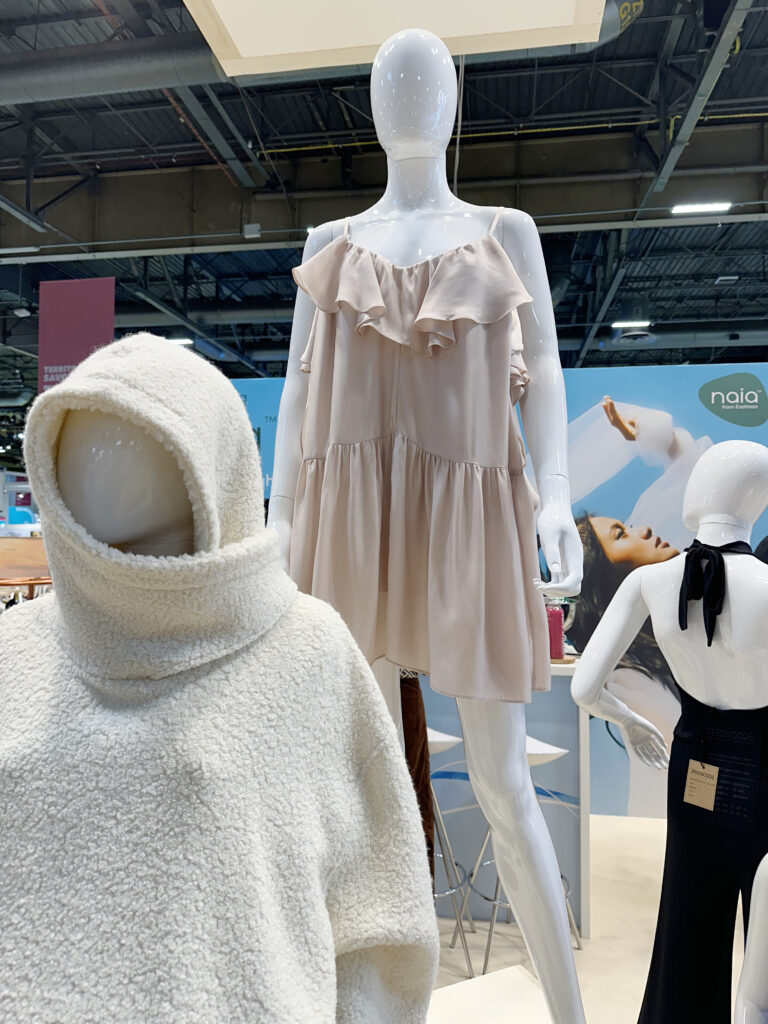
The family of man-made cellulosic fibres includes the likes of viscose, modal, cupro, lyocell, and acetate. American material innovation company NAIA, owned by Eastman Chemical Company, is sourced from 60% FSC certified wood pulp and 40% acetic acid.
— We don’t use any hazardous chemicals, it’s biodegradable, says Ruth Farrell, General Manager. Wth the NAIA Renew portfolio, 40% is sourced from recycled content that’s GRS certified. A couple of years ago, we introduced NAIA Renew ES, which is enhanced sustainability, where we have 60% recycled content. So, our innovation platform is very much about improving the percentage of recycled content and also improving the percentage of recycled content coming from textile waste.
— Our vision is to make sustainable textiles accessible to all. When we look at the portfolio of offerings, we have filament yarn, we have a staple yarn, and now we launch NAIA Lyte, which is a filament yarn with enhanced strength to allow us to get into the lower-weight fabrics. So, we’re a fibre and a yarn portfolio that can be in a huge number of different sub-segments of fashion, from ready to wear to streetwear to athleisure to casualwear, and denim.
And that seems to be key when it comes to such innovations, the versatility, in order to scale and that you can adopt it in the already existing value chains.
— Yes, and you need to be mainstream. You need to be on the high street as well as in all of these different application areas. So, that has been our effort with mills over the last several years, just building the number of applications where we can play a part.
In terms of price, are you competitive compared to other fibres?
— Absolutely. We believe in democratising sustainable fashion, and part of making it accessible is to make it affordable, so we’ve invested quite a significant amount, and we’re at commercial scale. We’re manufacturing in the US, in Tennessee, and now with NAIA Lyte, we’re manufacturing in China, which helps us to serve a lot of the value chain that’s based in China, with improved logistics as well.
More in general, what are the keys in order to further increase the amount of hard to recycle textile and innovations like yours?
— Something that’s sustainable on its own without delivering aesthetic beauty or functional benefits like ease of care or durability is not enough anymore. You need to be sustainable and innovative as a fibre or yarn offering, that’s number one. In 2024, there was quite an intentional focus from brands on improving sustainability. In 2025, we saw people had a… let me just say that sustainability wasn’t everyone’s number one priority.
— I do believe regulation is needed. But there are also quite a number of brands we’re working with that have science-based targets or public sustainability goals that they are quite focused on. But there’s a spectrum of brands. There are many brands that might be waiting for regulation before really making very intentional moves. It’s a little bit like the food industry, where the ‘clean label’ and similar things were really accelerated by regulation.
And another key is that we go from sustainable capsule collections…
— To core. Yes. Across the brands, when we started, eight, nine years ago, it was all capsule collections, capsule collections. But we are actually beginning now to move into the core collections. And as I said, some of it is showing people the versatility of your yarn, the accessibility of it, the affordability of it. And you know the benefits it brings beyond sustainability, be it aesthetics or drape, hand feel, luster or functional, be it the comfort, the wear experience, or the durability. So, we’ve spent a lot of time working on the ’and’—sustainability and that value proposition—and that has been key.
And what’s the next big thing for you?
— We’re launching NAIA Lyte now and are working with mills in China already, and are starting to work with mills around the world. It’s going to be really exciting to see what people do with NAIA Lyte. The fabrics are luxurious, elegant and very much on trend when it comes to the fashion for lightweight fabrics. I think a lot of application development is going to be done in that space.
— We’re also continuing to push the percentage of recycled content, as well as a lot of work behind the scenes, testing different feedstock sources that have circular content.