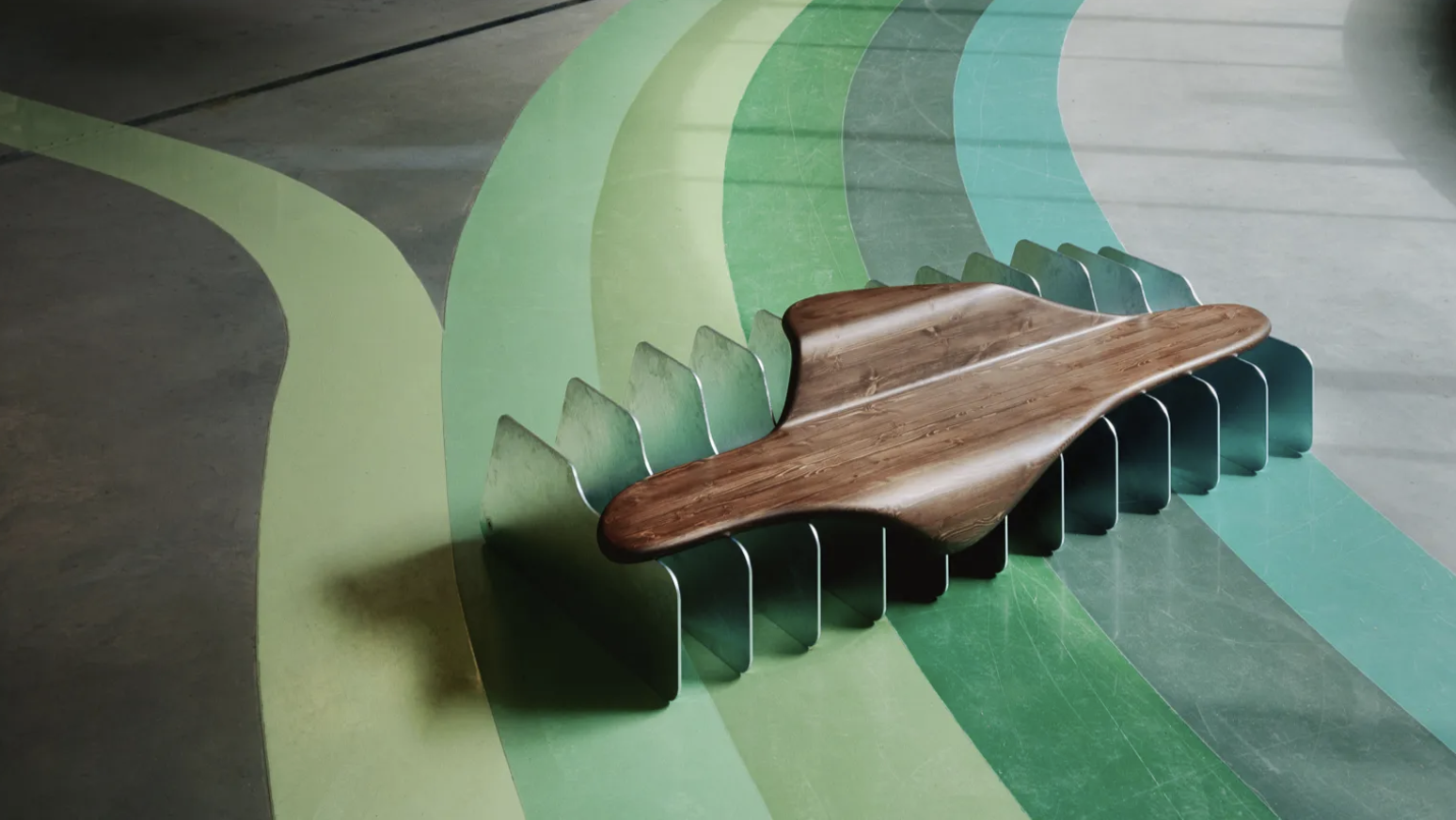


This season, Iittala’s collection is inspired by natural elements, the brand heritage, and traditional Finnish craft.
— When I moved back to Finland after almost 15 years, I was mesmerised by the craziness of the midsummer sun, says Janni Vepsäläinen, Creative Director. As a brand, we’re often inspired by nature, so it’s a very natural place for us to start when we think about designing new products. In the Nordics, we live with it every day: the shift in the light and how it affects us both emotionally, physically, and socially. So, this is a celebration of the midsummer sun.
The true DNA of the brand, Vepsäläinen continues, is the mouth-blown handcrafted glass Made in Finland.
— Whenever we start a new collection, there is a concept and an idea, but then, we immediately go to the glass factory. That’s where the whole creative process starts, and where we ideate new products. It’s also about making sure that we maintain those century techniques that we only hold and that is not in a written form. You can’t go to university and learn glass blowing. You have to learn it from the masters, so we always have two master blowers and some younger blowers to make sure that we maintain it.
— The designer Kaj Franck, who worked for Iittala, has said that colour should be the sole decoration of an object. This collection is the first time we have explored Finnish sand, except for a small project on Aalto vases last year. It’s high in iron content, which is why it’s green, with no additional colours put into it. It’s simply naturally green.
— We also have a little sneak preview: this autumn, we are launching scented candles, where the scents are inspired by glass blowing.
Are there any other developments in your sustainability work?
— Everything that we do is, of course, rooted in the principle that we are creating long-lasting design, from a durability approach but also from an aesthetic point of view, creating products that are meant for everyday use from generation to generation. The Aalto candles (the scented candles, Ed’s note) are designed in a way that they are reusable, so once you have burnt the candle, you can use the vessel to plant a flower or for other purposes. There is a multifunctionality in everything; you don’t need to buy a different glass for white wine, red wine, and beer, but you can actually use one vessel for all your drinks. It’s about understanding the consumer needs, and how we, with less products, can answer to several needs.

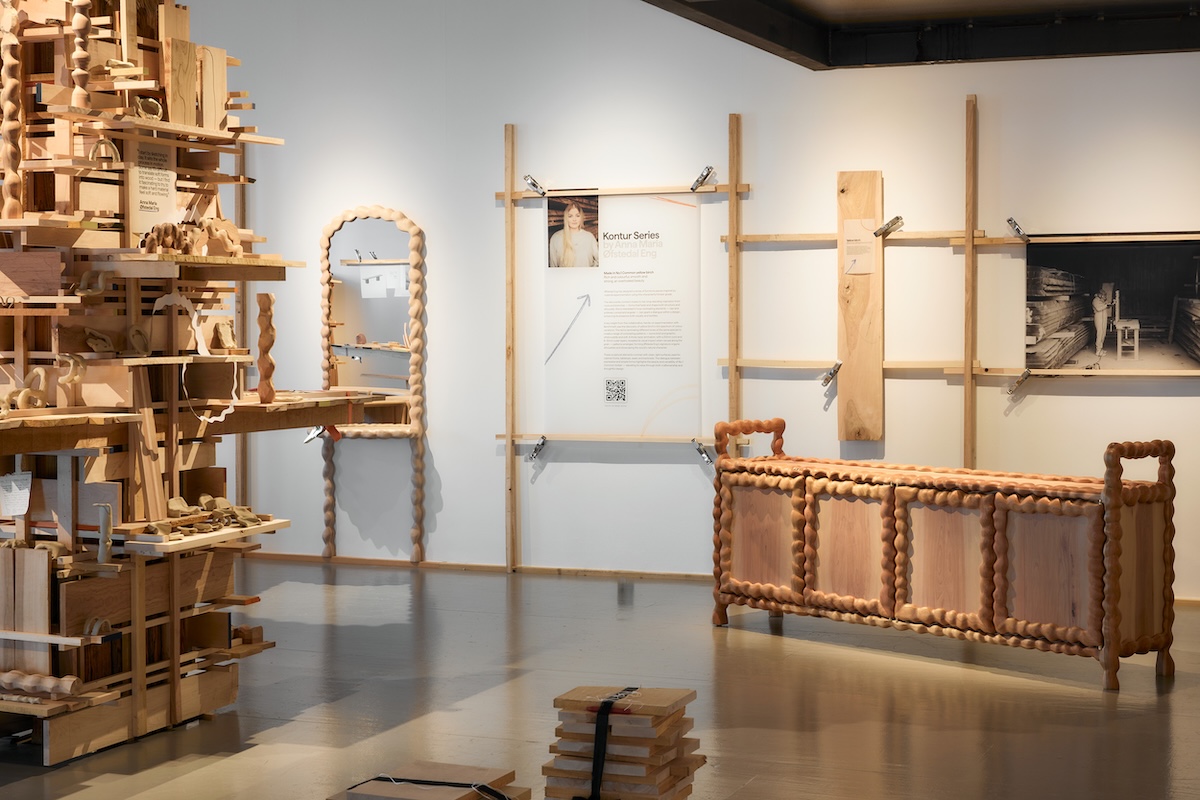
For 3daysofdesign, AHEC (American Hardwood Export Council) commissioned new works by designers Andu Masebo, Daniel Schofield, and AnnaMaria Øfstedal Eng, each highlighting the natural variety of timber. Named No.1 Common (also in the top picture), the exhibition aimed to make the case for often-overlooked hardwood qualities and species in design and championing a sustainable approach to material selection; use what nature provides. It also wanted to highlight how sustainable and thoughtful material selection can shape the future.
— It was a deliberate move on our part to bring in the material to a group of designers that manufacturers don’t normally see or work with, that had all this character and life. That is the most sustainable thing: to use what nature produces. How can you work with knots in timbers? Do you throw them away and waste them? Or do you actually put them in your product? One of the designers, Andu Masebo, chose to do that, says David Venables, Director, AHEC Europe.
According to the London-based Masebo, the No.1 Common has all the things that he finds the most interesting about timber.
— It’s about all the intricacies, the details, the mineral stains, the knots, and everything that makes it not a plastic product or object. I guess that all the people are coming here because of the furniture. My contrary opinion is that furniture in itself isn’t the most exciting thing in the world, but what it allows to happen around it, the lives that exist, and the memories that can be made in contact with furniture, is what makes it really exciting. I wanted to design a table and think about its social, cultural function, the idea that you go into a home, and it’s where you meet people around. Imagine a table as a centre of gravity and how you can draw people towards it.
The exhibition design, created by Kia Utzon-Frank (KUF Studios), was entirely made up of the offcuts from the production of the designs, crafted at Benchmark’s workshop in London.
— For us, it’s a lot of fun to be challenged and to work in a slightly different way. Normally, we’re trying to match a specification and say what we want it to look like. Here, it’s flipping on its head, saying that this is the material you’ve got. Then, we’ve got three designers who were really challenging us to do different things, and the outcomes are so interesting and varied, says Martin Penrose, Managing Director, Benchmark.
Not having a pure brief enabled Norwegian designer AnnaMaria Øfstedal Eng to conduct her own artistic design research.
— I have a bit more of an organic shape expression, and for me, it was a big material inspiration, being all about wood. I loved to see its own identity, history, and imperfection, she says, adding,
— I’m used to making everything myself in my own workshop, where I do a lot of big things… We’re used to seeing wood plain and square, but I like how it develops something that is more tactile, showing its amazing characters, and that it can be truly mesmerising in objects.
— AnnaMaria’s work is not something that you naturally can make in wood. Now, I look at it, and I still ask myself how the hell we made it…, says Penrose.

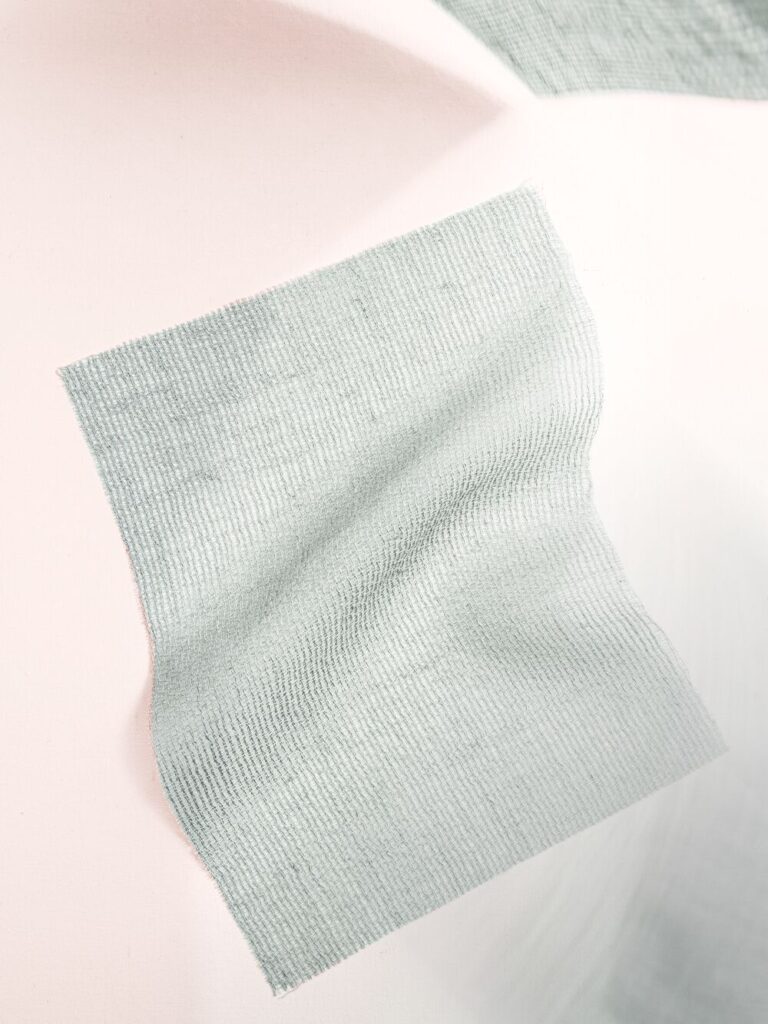
Danish textile producer Kvadrat has introduced several innovative fibres, such as undyed llama, hemp, and alpaca, over the last few years. The new Frequency collection adds pineapple leaf fibre (PALF) from traditionally discarded pineapple leaves to the range. It’s a natural and renewable fibre extracted from the long leaves of the pineapple plant, a byproduct of fruit cultivation. Kvadrat has developed Palf with material innovator NextEvo over the past two years, and the fibre has been mixed with Tencel.
— It’s extremely soft, regenerative, and provides different characteristics and a different micron. When you touch it, it creates a new experience, which can not be reached by either linen or cotton, Creative Director Isa Glink explains. She adds:
— Regenerative fibres are all-natural fibres, and this comes from the pineapple plant, which is transformed and spun with Tencel, made from wood pulp in a closed-loop spinning process, to be able to weave it.
The Danish national business cluster in design, fashion, and furniture Lifestyle & Design Cluster took to Designmusuem for a panel discussion titled The Next Generation of Circular Solution Providers. According to one of the panellists, Viggo Stenseth, co-founder of Web3 and blockchain specialist Lingon Certificates, the design industry is stuck in a broken conversation.
— Producers of great things have no relationship with their suppliers beyond the first level. It’s not because they don’t want to; it’s just that data and conversations aren’t flowing. Even worse, I think there’s no conversation happening between the producer and the user. There’s a reseller in between. It’s silence. We’re stuck in a produce-sell silence cycle, and we need to change this behaviour. But if you’ve ever studied to change things in organisations, behaviours are probably the worst thing to go after and change. That’s very, very hard to change, he says, continuing,
— The result of this broken conversation is 10 million tons of furniture waste in the EU alone every year. And it’s not because 237,000 furniture and lighting companies want to do badly. They all want to do great. They do great. And, we have a simple solution to this very complicated problem. By 2027, the chair over there needs to be able to speak. The EU Digital Product Passport regulation demands it. And we say, just put a chip in it. By doing this, we establish communication. When you scan it, it turns into one tap upgrade, one tap resell, one tap track, one tap make a complex choice.
Lingon has done eight pilots so far, with small as well as really big brands. Stenseth explains that the company works with furniture companies in Sweden ”who’s never had to talk to their suppliers in this way before.”
— Now, they have to sit down and ask, ’What is in that paint?’ ’Where do you source the granulate from?’ And their (the suppliers’) reply is, ’I’m not really sure, I have to check.’ We’re on this journey, we have to solve it together, and I’m super optimistic because there’s real business value in this. It makes sense to keep things in the loop and add value for the producers that already want to do good. You have the sub suppliers that make amazing things and have great certifications. Take FSC, they put so much blood into how they handle materials. Let that float with a chip all the way out to the user and interact, and you can establish a relationship, hopefully for life.
As with all things tech, the issue with counterfeiting always comes up, but Lingon aims to be one step ahead.
— We have several different chip technologies and work with blockchain technology, meaning we write to a database that is owned by all. You can’t change things, you can’t erase history. And that gives us an edge in how we can leverage things to make something that is uncopied.
— The furniture industry is primed for 2027. It is rigged up. It has to happen. And you can tap into collectables. You can tap into loyalty. How amazing to send a message to someone that you sold the piece to 15 years ago. ’Thank you for holding my piece for 15 years, do you wanna come to my showroom?’ Now, you have this opportunity, you have a data link, you can send that message and invite them. I think that is fantastic.

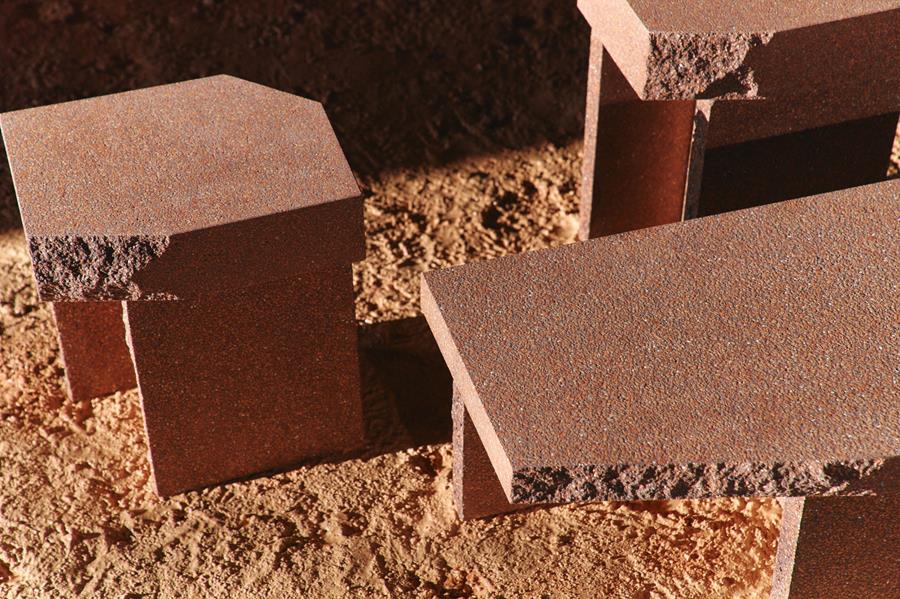
The byproduct of terrazzo marble chips has typically been used in toothpaste or roads. Six years ago, industrial designer Alberto Bellamoli’s family company asked if he could find new applications for it.
— We started to analyse the waste stream of the company and how we could do something with it that was upcycling the value of it, to retain the value of the marble. It’s not a renewable resource, at least not in our lifespan, so to make the most of what was already existing was our goal. We managed to develop a process that uses a mixture of our leftover marble dust, marble chips, and binding with concrete, he explains, continuing,
— By squeezing them together with a high level of pressure, we get a very strong, resilient material, whose main use is outdoors. The initial point was the upcycling of material, but we also wanted it to be beautiful. It would not be my first selling point to say it’s sustainable. Instead, we wanted to do something that was actually interesting, that could be a platform for other designers to do something cool with.
The material, named OUTT, debuted in Fogia’s new outdoor range Kern, created by Swedish designer Monica Förster.
— It’s an interesting material, and a brand new innovation from a 96-year-old family company, she says. The approach was that we designed with the material as a starting point and broke off the edges on some parts to create a system. By doing it asymmetrically, you can suddenly turn it and vary the formations in a very diverse way. Also, the possibility that it can come really, really thick and super thin is quite interesting. And we just started to develop more colours. But the nice thing is that it’s real material. It’s the stones that create. It’s not colored. It comes from nature, and is made by man. It’s an artistic approach.
Alberto, except for marble, have you also looked into other kinds of stones to utilise waste from?
— Yes, two. The first line is with the leftovers of the granite industry in Italy. Secondly, there are olivenites, which are very interesting. It’s a natural stone between marble and granite, but it has a peculiar property that it’s able to capture CO2 from the air. We already did some prototypes, and it’s very interesting to have a material that you include in your block, and the block is absorbing CO2 throughout its life, especially in the draining version, when you have more surface open. It can basically make our tile carbon-negative, but it requires time. If you want to be serious, you need to do a chamber control absorption test.
— We want to do our own life cycle assessment of each and every process that we do in the company. When we have met them, of course, we have the environmental footprint, but we can also go and intervene where we see that we are wasting resources or something doesn’t work as it should. It’s not sustainable until we prove it!