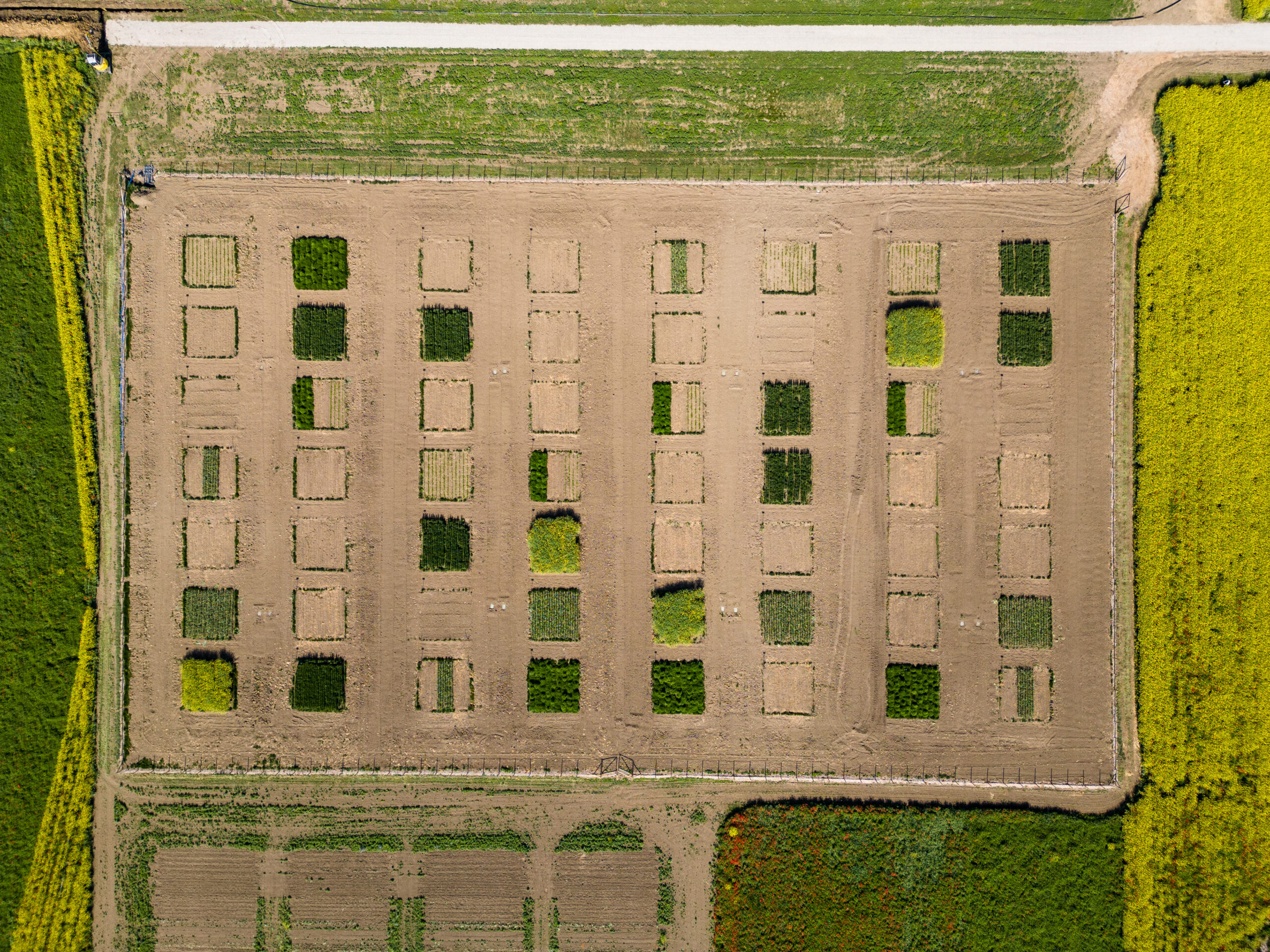


In 2021, haircare company Davines Group teamed up with Rodale Institute to open EROC (European Regenerative Organic Center, pictured) directly outside its headquarters in Parma, Italy. The research centre focuses on conducting cutting-edge research, training, and extension activities to demonstrate the numerous beneficial effects of regenerative organic agriculture across various sectors. The project has grown substantially since.
— It’s now 17 hectares. We use it as our hub for research, innovation, and training new farmers, says Elena Chisena, Davines Sustainability Business Partner. In 2024, we established The Good Farmer Award to reward farmers who have already launched projects inspired by the fundamental principles of regenerative organic farming and agroecology. The objective of the Prize is to contribute to the dissemination of a new culture of agricultural production that supports the ecological transition of agrifood supply chains, among other goals.
— The centre consists of 188 research plots where we grow 22 different plant species with traditional agriculture and regenerative organic agriculture (ROA), and we measure different environmental indicators. We are registering and measuring numerous benefits of regenerative organic farming, including improved soil quality, enhanced biological diversity, increased carbon sequestration, and better regulation of water and nutrients in agricultural soils. We aim to disseminate this new data to educate more people and convince them to adopt ROA.
— The shift is what matters, to make people understand that this is something that can be done at scale. It doesn’t have to be a small farm for one person that just feeds the family. We can actually scale it. Of course, we don’t think that this is a one-key solution, but that we need to implement different solutions to contribute to solving problems.

EROC is ROC certified since 2024, a strict certification that is difficult to achieve.
— Now we’re working on a new project that you will hear about soon, which will bring regenerative organic agriculture to a new level. At the end, our ambition is always to create beauty that regenerates. We aim to include more and more ingredients from regenerative organic agriculture into our products. By 2030, the goal is to have at least 80 in our formulas. We don’t want this to be just a limited-edition product or a gift with purchase (GWP). We want to include regenerative organic ingredients into our product portfolio, into the new products and lines, and our R&D department is currently working on it.
— Over the past two years, we have studied and validated 21 ROC ingredients for use in our formulas in the laboratory, 8 of which are already present since the end of 2024: prickly pear, yarrow, mallow, elderberry, amaranth, myrtle, and red grape. Many of these ingredients are grown using regenerative organic practices by selected farmers in Italy. To date, two ingredients —yarrow and calendula — have been grown and certified by ROC at our EROC center in Parma.
For the past few years, Davines Group has worked on building its 2030 strategy, focusing on the environmental objectives, including climate, with the important commitment to SBTi (Science Based Targets initiative).
— In order to define the strategy, we had to understand key topics and priorities, Chisena explains. We worked to understand what we want to focus on and where we want to go. In 2022, we identified nine significant topics, referred to as material topics. These topics are relevant since our company can impact them, and at the same time, they can impact our company.
— We have gone beyond simply setting net-zero or climate action goals, or stating an intention to reduce carbon emissions by a certain percentage by 2030 or 2050. Instead, we have defined a strategic roadmap built on a portfolio of initiatives addressing four major environmental priorities: decarbonisation, water, biodiversity, and circularity. Moreover, we are taking extra steps to define and commit to tangible social sustainability goals, both internally, towards our employees, and externally, involving our communities.
How many sustainability goals do you meet in your company today?
—The sustainability goals we have set are designed with long-term impact in mind. Our primary targets are aligned with the 2030 agenda, and progress is assessed annually to ensure continuous improvement. For climate-related objectives, we have committed to a long-term net-zero goal by 2050. However, for the Science Based Targets initiative, a company has to identify short-term Net-Zero to maintain accountability and drive action, recognising that 2050 may seem distant and that intermediate goals are essential for meaningful progress. That is why we have also set an important emission reduction target to achieve by 2030.
— We constantly measure our performance and set annual objectives to track our results. In our recently published 2024 Sustainability Report, we provide transparent disclosure of our outcomes, clearly comparing actual performance against the commitments we made.

Once a year, if not more, Chisena shares, Davines gathers distributors of a specific geography and other partners for a full-day event called the Davines Business Forum. There, updates are provided on hot topics, such as sustainability and HR, while suppliers are involved to share results and set new goals to be reached through collaboration.
— We’re now working consistently on embedding sustainability at a commercial level. Our challenge is to translate sustainability efforts into tangible actions at a salon level. (Being a professional haircare brand, Davines main sales channel is hair salons, Ed’s note.) With salons, we cannot focus solely on numbers and technicalities; we must remain practical and relatable. Our approach focuses on embedding sustainability within campaigns, ensuring that diverse topics converge seamlessly. For example, initiatives around biodiversity often contribute to climate action, as these areas are deeply interconnected. Similarly, efforts to enhance circularity — such as phasing out virgin plastics in favour of recycled PPE and other materials — not only reduce waste but also lower carbon emissions.
— As a company, one of our core ambitions is to contribute to addressing climate change; however, this cannot be achieved without considering biodiversity, circularity, and water. We strongly believe in interdependence. It is essential to recognise and celebrate the efforts made across each of these areas, ensuring that no aspect is overlooked or taken for granted, because they are all deeply connected.
Clean beauty has been on the rise for a long time. But not for you?
— No. Our brand is deeply rooted in science, and the concept of ‘clean’ is not scientifically defined. Instead, we prioritise high-quality formulations, responsible packaging, and accurate labeling, supported by robust tools to measure and minimize our environmental impact.
— For products, one of the key tools that we use is a Life Cycle Assessment (LCA). With every new launch, we compare the previous version with the new one, aiming to reduce environmental impact wherever possible. This approach is also shared with our educators and partners: we do not create products simply to claim, ‘clean beauty.’ Our goal is not to position ourselves as a ‘clean’ brand, but to deliver scientifically driven solutions that genuinely minimise impact.”
— The problem, Chisena explains, is not about companies defining what ‘clean beauty’ means — it’s about the ambiguity of the term itself. If Davines interprets ‘clean’ as excluding ammonia in hair colour, while another brand defines it differently, we risk misleading consumers and creating confusion. People may assume we are all referring to the same standards, which can lead not only to greenwashing but also to further complicating an already complex landscape for consumers.
And the EU aims to tackle greenwashing with the Green Claims Directive.
— Yes. For nearly two years, we have worked to remove vague terms such as ‘sustainable’ or ‘clean’ from our claims. The directive requires any statement to be supported by certification and measurable scientific data, presented in a clear and verifiable way. We are fully aligned with this approach, as it reflects our values and principles. The challenge, however, is that consumers often lack the technical knowledge to interpret sustainability claims. Part of my role as a Sustainability Business Partner is to bridge that gap — translating accurate, science-based data into language that is accessible and easy to understand.
So, as a company, you can stand up and say that you’re working against greenwashing?
— Absolutely. We actively work to educate our consumers about greenwashing, aiming to give them the knowledge they need to make informed choices. We also train our sales teams not only on product knowledge but on sustainability principles, so they can clearly explain what greenwashing is — and what it is not. We recognise that this is a long and challenging journey. Internally, we often acknowledge that our approach can be complex and highly technical, which makes communication challenging. However, we believe that accuracy and transparency are essential to building trust.
— Our sustainability report is rich with valuable research and insights. However, for a salon owner, a 200-page document often has limited practical value. They have a different core business to focus on and will never go through a 200-page report, so we have created a short version with all essential highlights that we believe can be highly beneficial.
— The Davines Group Sustainability team is doing a great job trying to communicate with the highest level of accuracy, and within the Davines brand, we strive to translate their work into messages that are as accessible as possible. It’s a challenging task. Our clients, distributors, and sales teams consistently ask us to simplify the message — and we understand their frustration. The reality is that sustainability is inherently complex.
— You can simplify to a certain extent, but beyond that, it’s about building knowledge, awareness, and education. Oversimplifying risks, trivialising the complexity of sustainability—and Davide Bollati, our chairman, is very clear on this point: it’s not simple. However, we want to make them understand that there is a lot of work behind what we do, and we’re trying our best to bring them on the journey.
If you look three or four years ahead, what are the keys in the work you mentioned, to ’commercialise sustainability?’
— Community. We need to establish strong communication channels to effectively communicate with our people, including salon teams, educators, and salespeople, so that they can share what they observe in the field. Too often, we operate within a fixed strategy without a full understanding of what happens in salons. Active listening is fundamental: by understanding their needs, we can provide the right support and guide them on their sustainability journey in a way that makes sense for them, helping to grow the community and their sustainability practices, Chisena shares. She adds:
— Also, activation. The second priority is creating meaningful local engagement. If I talk about EROC and something based in Parma, for how beautiful that could be, someone in Greece may not relate to that. They need to connect with local organisations in their own market. That’s why we work closely with distributors, business units, and our community to ensure initiatives happen locally, where people can truly engage. And when they engage, it’s both physical and emotional — because sustainability is deeply tied to emotions. Our goal is for the community to become a multiplier of our message!