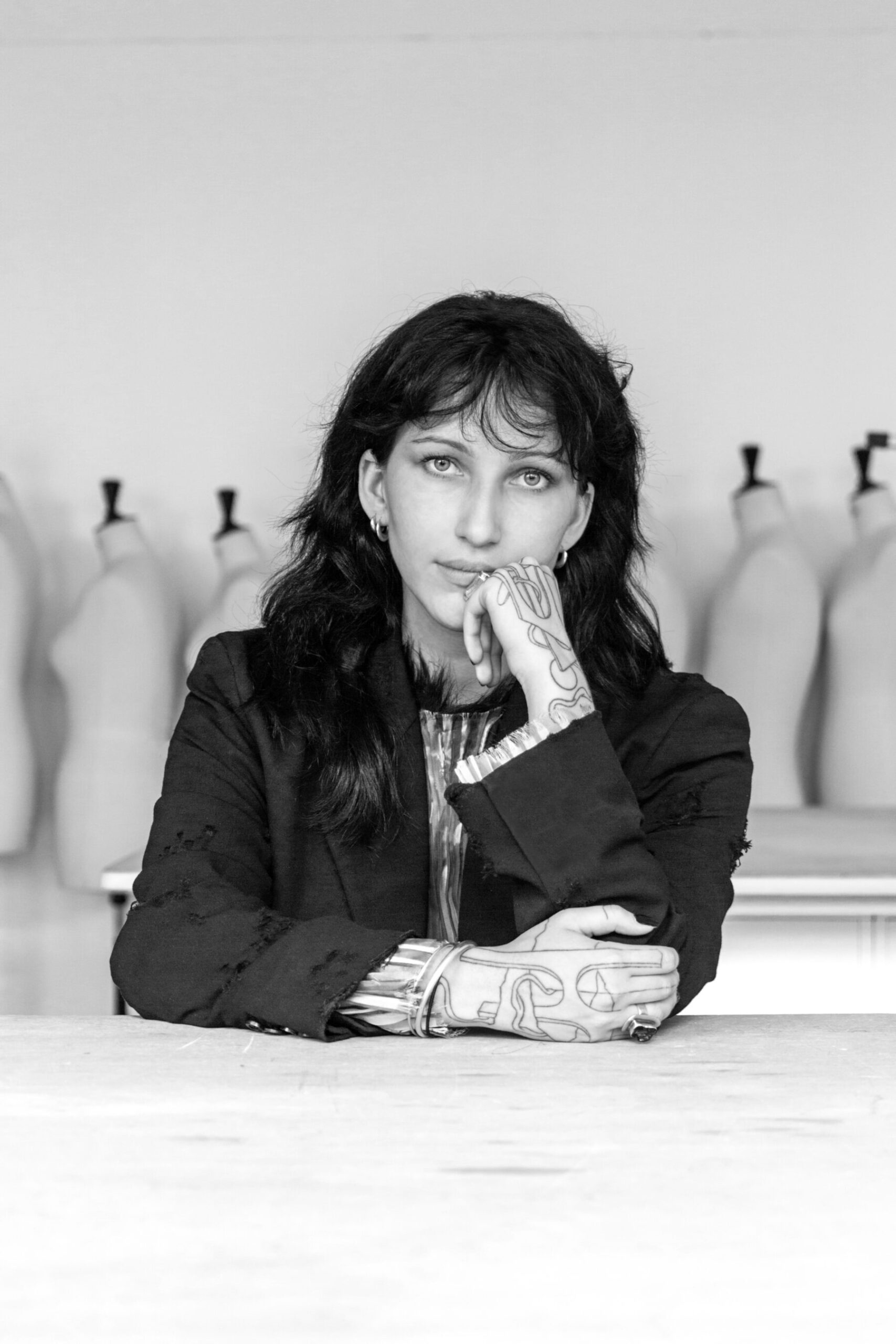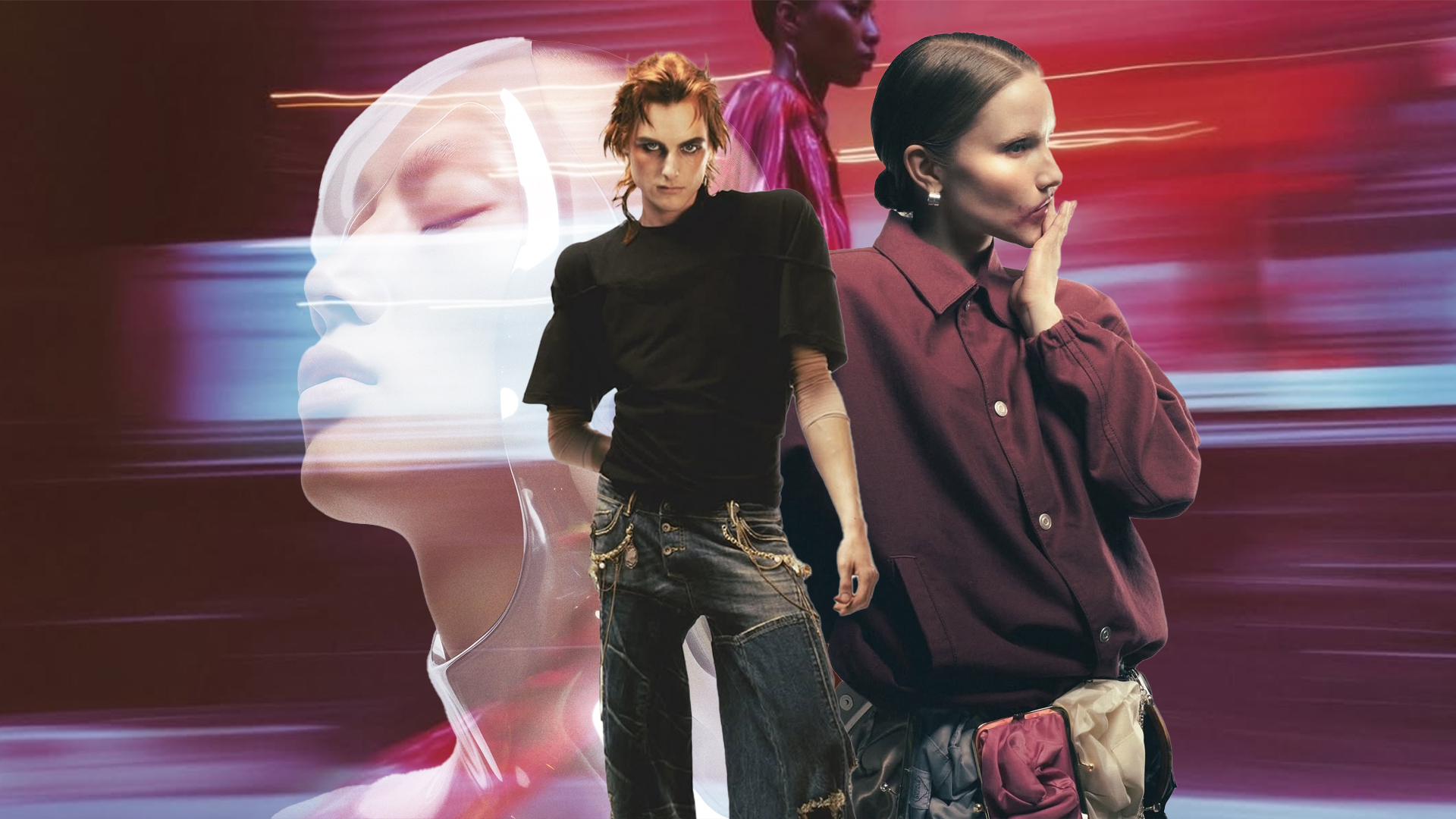


You may know her from the now-iconic Nike braces image, the tiny swoosh-covered retainer that went viral, reposted by Bella Hadid, and ended up licensed by Nike. Or perhaps from her collaborations with Balenciaga, e.l.f. Cosmetics, Marc Jacobs, and Valentino, among others. Or maybe you’re one of the 695,000 people already following her on Instagram.
Gab Bois, the Montreal-born designer and artist, holds under her talented umbrella everything from photography, video direction, art direction, object design and installation work, and in her own words, ”pretty much whatever other mediums my mind and body allow me to explore at once.”
Her work tickles, not scratches, your itch.
In a conversation about her craft, she reveals how her analogue way of working gives AI image-generation a run for its money, how the algorithm of today threatens originality, and why brands are queuing up to work with her.
What does surrealism say about our new visual culture?
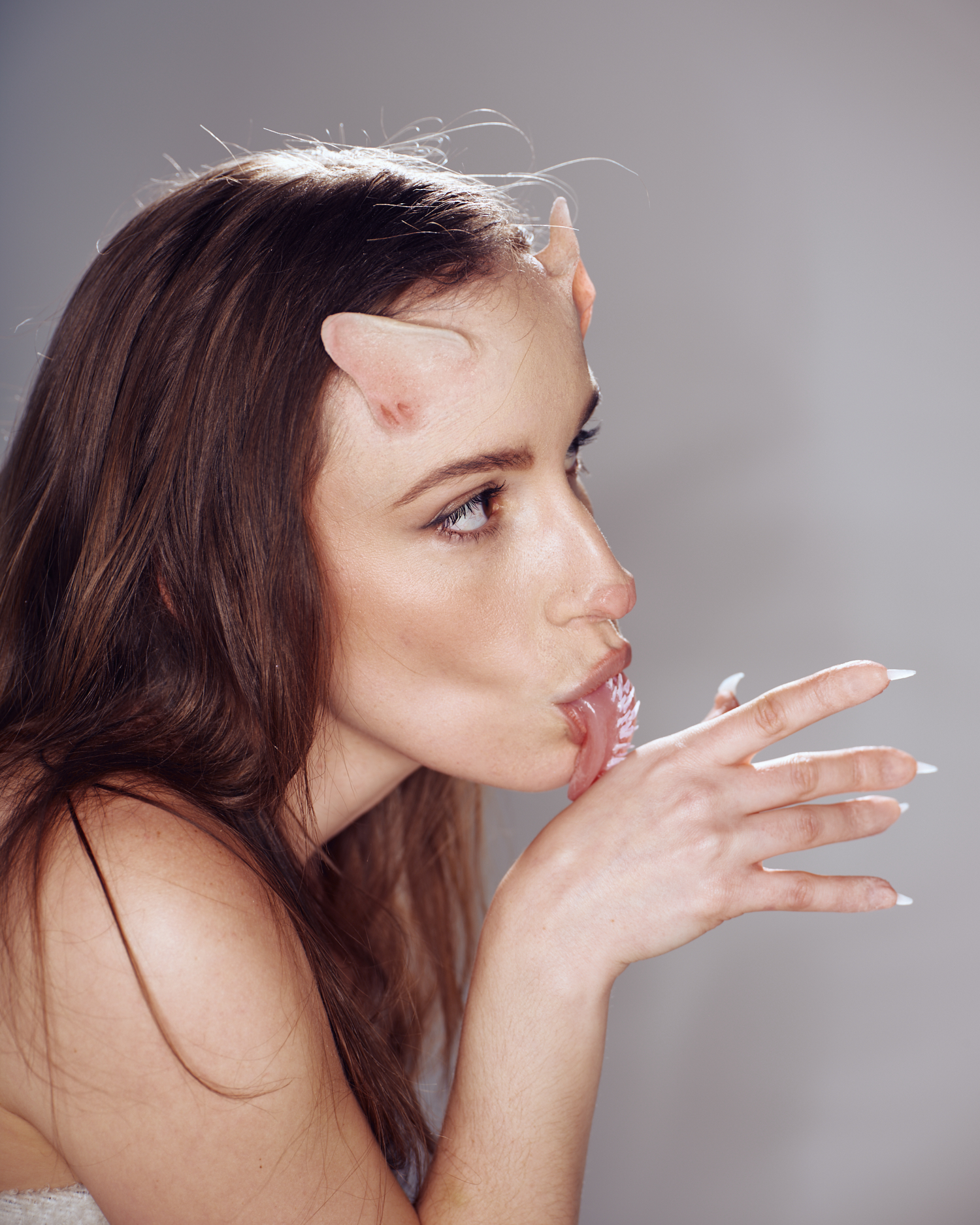
Strangely desirable and unsettling, Gab Bois turns the mundane into satisfyingly odd creations and it’s her stretch of imagination and ”raging ADHD” we have to thank for it. She shares, ”For as long as I’ve been making this type of work, my goal has always been to recreate the feeling of a real-life double take. Even as a kid, I’d catch things out of the corner of my eye, for example, a classmate sweeping the floor, and for a fraction of a second, my brain would register the broom as a small dog running around the classroom.”


Bois’s creations are often mistaken for AI, a confusion that reflects how surrealism is now becoming synonymous with AI-generated work. The glitch-like surrealism performs well online because it stops the thumb from scrolling, and in an attention economy, that’s gold. As a result, many people now assume that anything uncanny must be synthetic, a misconception that Bois has responded to in her instagram bio, which reads ”not ai”. Her process runs a little differently:
”I’m deeply drawn to analogue making, building things with my hands, touching materials, interacting with them in ways that are unpredictable,” she says.

Bois’s ability to turn the mundane into something unexpected is central to how her images create that momentary emotional pause in a viewer’s scroll.
”Because it’s familiar,” she explains. ”We’ve all seen these objects thousands of times, so when the routine is disrupted and something ordinary appears in an unexpected way, the surprise is stronger. It creates a tiny cognitive and sometimes even emotional pause where your brain has to recalibrate. That’s the space I aim to work in.”


Her process sits at the opposite end of the spectrum from prompt engineering, not in value but in method. While AI relies on iterative prompting and refinement, Bois embraces the slowness and physicality of building an idea by hand.
”Even in post-production, I tend to edit my images on a single layer in Photoshop, like a painting,” she says. “That echoes what I love in the physical world too, working with hundreds or thousands of repeated objects, arranging them one at a time.”
As automation accelerates, her analogue process stands apart.
With all this work then comes sharing it online. Social feeds are increasingly shaped by algorithms that promote what is already performing well, which means audiences often end up seeing variations of the same visual ideas rather than genuine discovery. This environment sits in tension with Bois’s slow, physical process and her desire to create pieces that pause the scroll.
”There was a time when Instagram felt like the best place to discover new artists and visual ideas. It still can be, but the experience has shifted,” she explains. “It used to be like going to the thrift store and going through endless racks of clothes of different styles, sizes, colors, seasons, digging for treasures, but now it’s more like we’re all shopping from the same H&M flagship.”
Brands want the Gab Bois effect, and understandably so. In a landscape where campaigns often blur together, her analogue surrealism feels idiosyncratic and recognisably hers. Keeping that identity intact within commercial work is important to her, which is why she gravitates toward collaborations that stretch her creatively rather than dilute it.
”When I’m considering a partnership, I ask myself how the work can elevate both sides, how it can push me creatively, whether through the vision, the scope, or the chance to explore a new discipline, while also elevating the client’s brand or product.”
Bois’s craft-driven perspective becomes even clearer in her commercial projects. In her recent collaboration with Away, she and the brand built an eight-foot-tall suitcase and photographed it on the streets of New York. The concept could have been generated by AI, yet what mattered was everything a prompt cannot produce.
”The real-life reactions, the laughs, the double takes, the people stopping us on the street can’t be fabricated digitally,” she says. ”The physical suitcase will continue touring in real exhibition spaces tied to travel culture, which adds another layer of lived experience that AI and even social media marketing simply can’t replace. The human interaction and experience is what I respond to most as a consumer, and it’s what I love creating as a maker.”
Gab Bois’s ability to reshape how we see the ordinary is what makes her one of one. The fact that her projects are so often mistaken for AI reveals how visual culture now defaults to the synthetic, but her practice shows what happens when surrealism is built rather than generated. In a fast, automated attention economy, her analogue approach is not an act of resistance as much as it is a commitment to presence, to touch, to problem-solving in the real world. Maybe that’s why going analogue works, and maybe why she’s nearing one million followers.