


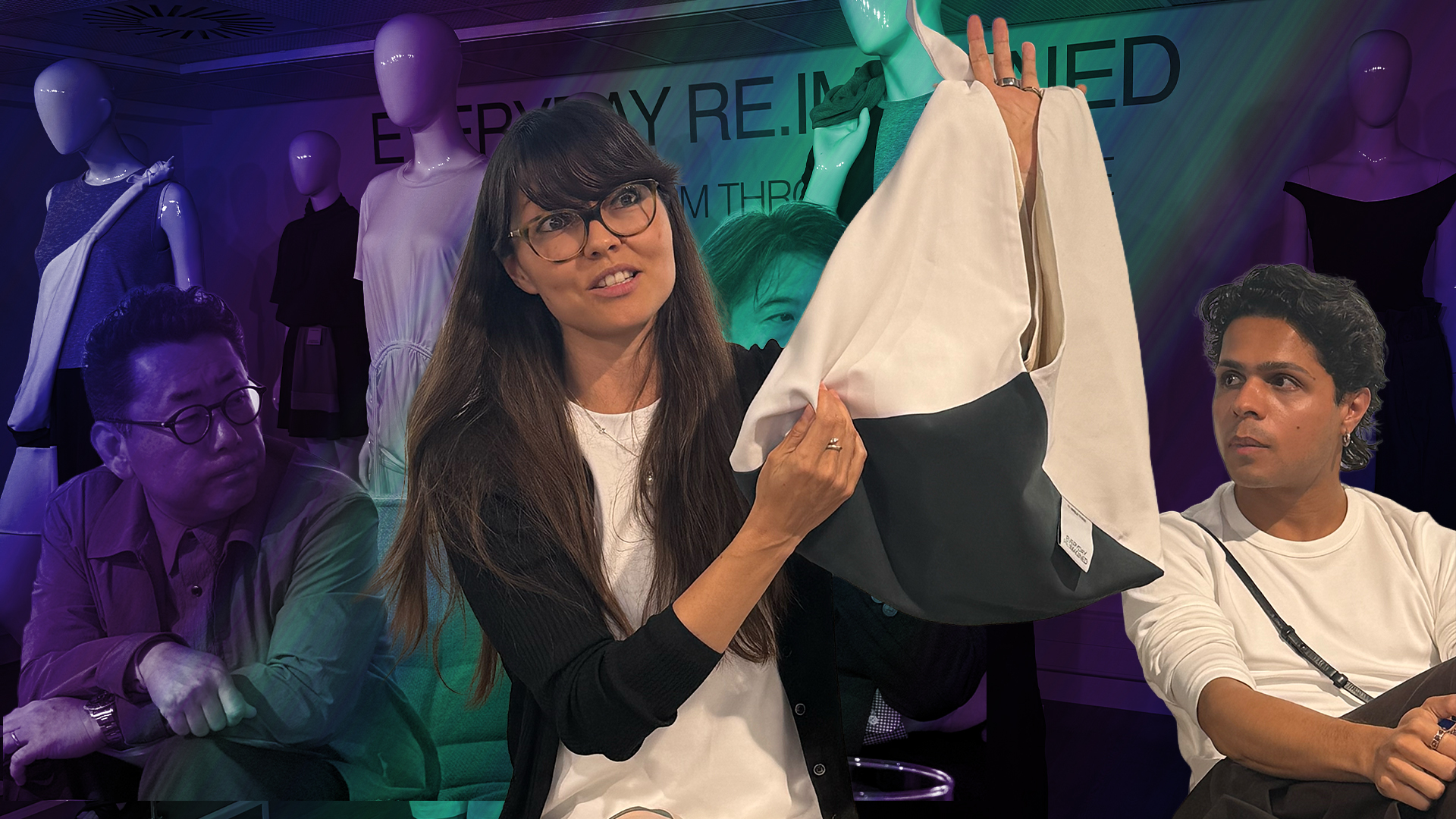


During a roundtable in London earlier this summer, executives from Fast Retailing and UNIQLO met with selected press at the company’s London headquarters to present their latest Integrated Report.
The overarching message was clear: sustainability is no longer being treated as a separate ESG exercise, but as an integral part of the company’s product development, supply-chain management, and long-term growth strategy. The report presents considerable progress, from operational emissions and renewable electricity to recycled materials and repair services. At the same time, it sets out an enormous commercial ambition. Fast Retailing wants to increase annual sales from ¥3.4005 trillion to ¥10 trillion.
Here are five takeaways from the report – and what its numbers reveal about UNIQLO’s attempt to make circularity compatible with global growth.
1. Sustainability is becoming part of the growth strategy
Fast Retailing recorded its fourth consecutive year of record performance in FY2025. Group revenue increased by 9.6% to ¥3.4005 trillion, while business profit grew faster, rising by 13.6% to ¥551.1 billion. UNIQLO accounted for ¥2.9363 trillion of that revenue through a network of 2,519 stores. Europe was one of the company’s strongest regions, with revenue increasing by 33.6% to ¥369.5 billion and business profit growing by 23.7% to ¥54.2 billion.
Yet these figures are presented as a stepping stone. Fast Retailing has set a long-term target of ¥10 trillion in annual sales – almost three times its current revenue.
What distinguishes the latest report is the way this growth is connected to sustainability. Product longevity, lower-impact materials, efficient production, repair, reuse, and customer trust are framed not simply as corporate responsibilities, but as sources of future competitiveness.
The underlying proposition is that better products and more responsible systems can strengthen customer loyalty while supporting commercial expansion. Sustainability, in other words, is being positioned as growth infrastructure.
2. LifeWear gives UNIQLO a credible head start
UNIQLO’s strongest sustainability advantage may not be a new technology or material, but the product philosophy it has spent decades developing.
LifeWear is built around familiar garments that are refined rather than replaced: down jackets, merino knitwear, functional underwear, and everyday basics designed to remain relevant across multiple seasons. Where much of fashion depends on novelty, UNIQLO has built its proposition around continuity.
The report describes this through two forms of sustainability. The first is emotional: creating timeless products that people do not quickly tire of. The second is physical, achieved through quality, comfort, durability, and lower-impact materials.
This distinction is important. Extending the life of a garment depends not only on whether the fabric remains intact, but on whether its owner still wants to wear it. A technically durable product offers little environmental advantage if it becomes aesthetically obsolete after one season.
– Circularity can be creative, expressive, and desirable. It is not only about extending the life of a garment physically, but emotionally. We want customers to enjoy and fall in love with what they wear, said Maria Ledous, Sustainability Manager at UNIQLO Europe.
UNIQLO also uses customer feedback to improve core products rather than constantly replacing them with entirely new ones. During FY2025, the company recorded 39.21 million customer and store feedback interactions, which were analysed and distributed across departments including merchandising, research and development, production, and e-commerce.
– When creating LifeWear, we are laser-focused on making, transporting, and selling only the garments customers want, in exactly the right quantities, explains Odilia d’Aramon-Guepin, Corporate PR and Sustainability Director, UNIQLO Europe.
Applied effectively, that system could help identify why garments fail, what prevents them from being worn for longer, and where small design changes could create more durable products.

3. Material progress is tangible, but uneven
During FY2025, recycled and other materials associated with lower greenhouse-gas emissions represented 19.4% of Fast Retailing’s total material use, up from 15.9% the previous year. The company is aiming to increase this figure to approximately 50% by 2030.
Progress has been significantly faster in polyester. Recycled polyester accounted for 46.4% of all polyester used, compared with 41.5% in FY2024.
This is an important distinction. Having almost half of polyester come from recycled sources does not mean that almost half of all materials used by the company are recycled. Across Fast Retailing’s complete material portfolio, the lower-emission share remains below 20%.
Natural fibres such as cotton and wool are more difficult to circulate at scale while maintaining the quality, price, and production volumes expected from a global retailer. Fast Retailing has begun incorporating recycled cotton into selected denim and UT products, but closing the gap between the current 19.4% and the 50% target will require progress beyond materials that are comparatively easy to replace.
A similar divide is visible in the company’s emissions data. Scope 1 and 2 emissions from stores and main offices had fallen by 83.3% in FY2024 compared with the company’s 2019 baseline. Renewable electricity accounted for 84.7% of electricity used across these operations.
In the supply chain, however, the reduction was 18.6%. Fast Retailing has consequently raised its 2030 supply-chain target from a 20% reduction to 30%.
The difference illustrates where fashion’s hardest environmental work remains. Switching stores and offices to renewable electricity can deliver relatively rapid results. Transforming raw-material production, fabric mills, garment factories, and other upstream processes is considerably more difficult.
4. Repair is moving into retail – but remains small in scale
UNIQLO began introducing RE.UNIQLO Studio repair and remake services in 2022. By October 2025, the concept was available in 67 stores across 23 markets, up from 51 stores in 22 markets one year earlier.
The studios offer paid repairs for holes, seams, zippers, and buttons, alongside remake services using embroidery and Japanese sashiko stitching. They also host workshops intended to encourage customers to care for and customise their existing clothes.
The growth is promising, but its scale remains limited. UNIQLO operated 2,519 stores worldwide during FY2025. Comparing the company’s reported figures – whose dates differ slightly – means RE.UNIQLO Studio was present in less than 3% of the global store network. This is not necessarily a criticism of the initiative. It is a measure of the distance between a successful experiment and a service that forms part of UNIQLO’s everyday retail infrastructure.
Fast Retailing also donated 4.74 million used garments during FY2025 through its work with the UN Refugee Agency and other organisations. Since the collection programme began in 2006, cumulative donations have reached 63.71 million items.
Donation can extend the useful life of clothing and provide important humanitarian support. It should not, however, be confused with closing the material loop. A donated garment will eventually reach the end of its wearable life and still require an effective recycling pathway.
UNIQLO is developing clothing-to-clothing recycling for down and selected polyester-rich garments, but these initiatives remain relatively small compared with the scale of its production and retail network. The next step will be to disclose not only how many items are collected or donated, but what proportion is repaired, resold, recycled into new clothing, downcycled into other materials, or ultimately discarded.
5. The real test is whether impact can fall as sales rise
The central tension in Fast Retailing’s strategy is also the simplest: can a company nearly triple its sales while reducing its absolute environmental impact?
Longer-lasting products, recycled materials, renewable energy, and more efficient factories can all lower the impact associated with each garment. Those improvements may nevertheless be outweighed if the total number of products manufactured and sold continues to increase.
This question is becoming particularly important in Europe. The EU’s textile strategy envisages a market where products are durable, repairable, recyclable, and increasingly made from recycled fibres. Digital Product Passports will introduce new demands for product-level information, while Extended Producer Responsibility will make brands more accountable for what happens after their products are discarded.
– There is a great deal of inactive inventory around the world–not only in our business, but across the industry. If we can achieve greater efficiency and produce closer to actual demand, some of fashion’s sustainability challenges can be reduced, says Kazumi Yanai, Group Senior Executive Officer, Fast Retailing
– We look at demand and production and try to forecast as accurately as possible. If we can produce the right quantity of garments, at the right time, the business can prosper while reducing inefficiency and excess inventory.”
Since July 2026, large companies have also been prohibited from destroying unsold apparel and footwear under the Ecodesign for Sustainable Products Regulation. Brands are instead expected to improve inventory management and develop alternatives including resale, remanufacturing, donation, and reuse.
For UNIQLO, circular infrastructure is therefore becoming more than a reputational advantage. The systems needed to trace, maintain, collect, sort, and redistribute products are increasingly a condition for competing in the European market.
The company’s future reports will need to connect its sustainability initiatives more clearly with absolute outcomes. The most revealing figures will be the total use of virgin materials, the number of repair transactions, the proportion of collected garments returned to clothing production, and whether supply-chain emissions continue to fall as revenue grows.
UNIQLO’s product philosophy gives it a credible foundation. Its timeless designs and focus on continuous improvement are naturally compatible with longer use. The company has also demonstrated that repair, reuse, and recycling can exist within one of the world’s largest apparel businesses.
The next challenge is to move those systems to the centre. The real test will not be whether UNIQLO can repair or recycle individual garments, but whether circularity can expand as quickly as the company itself – and whether ¥10 trillion in sales can create more value without simply creating more clothes.