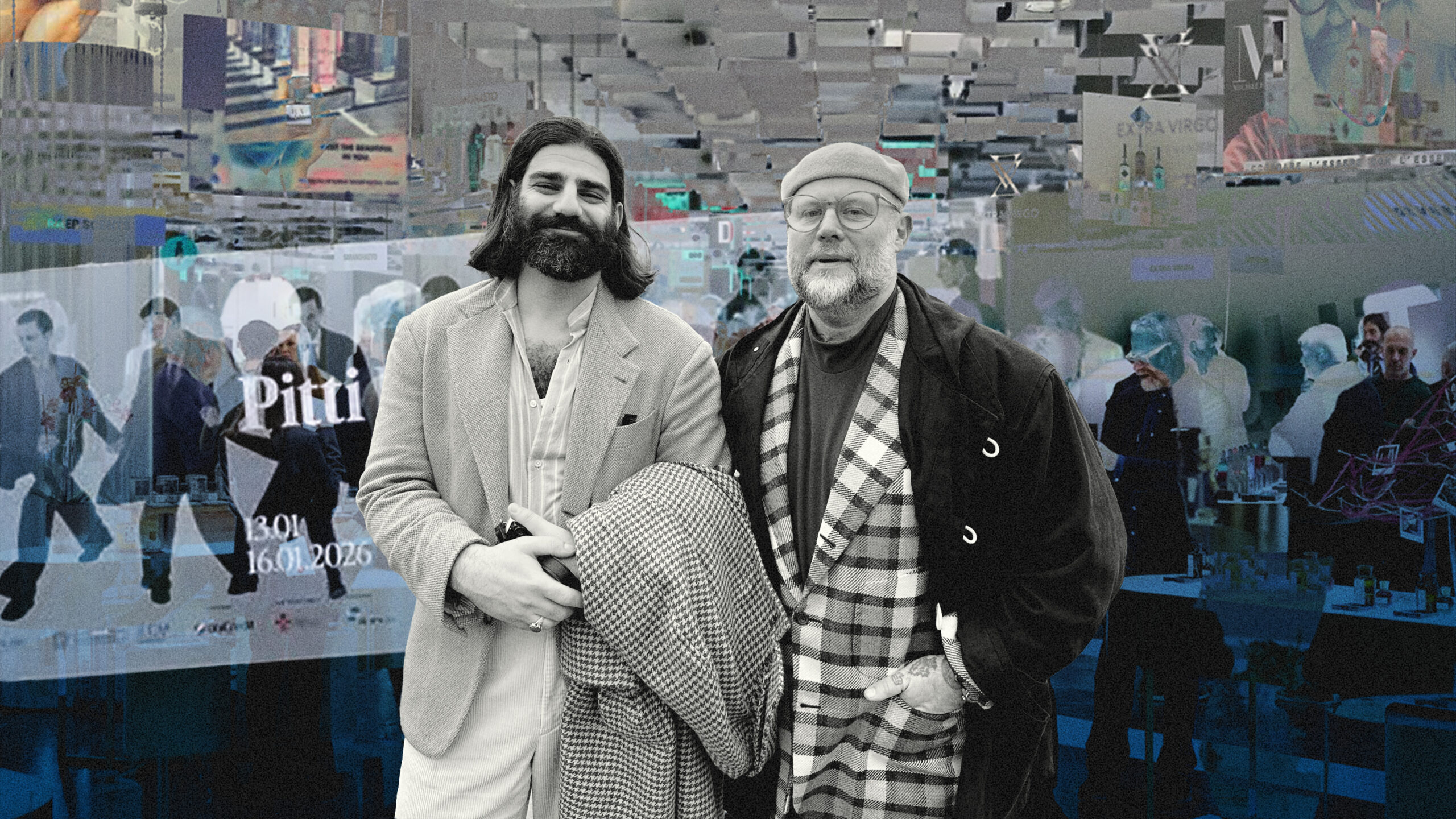


Michael Leahy, Strategist, Menswear at trend forecasting and consumer insight agency Future Snoops, experienced a busy fair. Currently working on the Fall/Winter 27-28 and Spring/Summer -28 season, he found certain halls at Pitti particularly relevant.
— We will always have the ones with heritage brands, but it’s interesting that they also split up with spaces for innovative, new brands, and others that I’m glad to see coming back, such as (Italian fashion brand) Gimmi Jeans.
And why them? Because of their use of hemp as a material?
— Exactly. With sustainability being such a buzzword, and with all the greenwashing, I haven’t seen such things from other brands on that scale. That definitely stuck out to me, especially being such good stuff too; it looks neat and stylish.
What else do you look for at trade fairs like this for your agency’s work?
— It’s more about needs and what I think is emerging. You know that at a trade show, everyone’s showing up with everything they have, making it even more important to find innovative, new things that are also commercially viable. Finding that middle ground is what I’m looking for — anything new and with its own niche, but that still has legs is worth paying attention to.
But it’s also challenging to be innovative and to scale a business.
— That’s why it sucks sometimes to see cool brands that maybe don’t come back — or maybe they did well, and don’t need buyers anymore. But yes, it’s definitely hard for the brands.
While for some, it can also be a good thing to do it small scale and show that you can actually survive as a brand.
— Yes. People are looking for authenticity, and mass production doesn’t exactly speak to authenticity, so if you can sustain yourself without having to go full scale and you have your own niche, that’s a good recipe. It doesn’t have to be big to create a change.

In Florence, London-based writer Anthony Sylvester took the opportunity to launch his book. An Informal Guide to Workwear explains why we can actually wear jeans to the office, and the history and culture behind it.
What are the takeaways from working with it?
— In general, the idea that something has an origin is slightly romanticising. Often, it’s just synchronicity, things happening in different places, and people reacting to needs. There was a great point in human history where it became cheaper to make clothes for someone than to replace that person. That’s the minute workwear came up. Unfortunately, the reality is that until that point, people were just thrown aside and someone else came on the job…
Freelance photographer Milad Abedi attends Pitti to work for brands and spend time with industry professionals. Over the years, many of them have also become close friends.
— It’s become a great community throughout the years that you meet twice a year, he says. It’s definitely great for networking.
— That’s what makes it so special, Sylvester agrees. We’re from all over the world, doing this. What’s the chance? It’s almost like the excuse to be here is to have dinner with friends.
And how have you seen the show develop?
— Now, he continues, it’s growing again. Pitti will always be relevant because there is actual work being done here. And, it’s increasingly focusing towards Asia. There’s such growth there. There seems to be more of a respect for tailored clothing in Asia than in Europe and America at the moment.

Ida Petersson, co-founder of brand strategy and creative agency Good Eggs, struck an optimistic note amid pressing global issues shaping the industry’s outlook for the year ahead.
– Despite being the ‘cold’ and generally less visited edition of the year, it’s had one of the strongest attendances from both global retailers and brands in recent years, which could be felt energetically around the fair. I’m excited to see the focus on Japan again, and was particularly enamoured with Soshiotsuki’s guest slot show, which illustrated perfectly why he was the LVMH winner last year.
Have you noticed any particular rising topics and industry trends when walking around the aisles?
– Pitti is obviously the centre stage for tailored ‘peacocking’ and is the place above any of the other fashion cities where the men really go for it, which makes for some fantastic viewings as seen on the street style photos. My takeaway, which has already been talked about on the women’s scene, was the use of accessories to really accentuate and make outfits original. From some amazing hats to bright scarves and my personal favourite: oversized handbags via Chanel and Bottega.
And what other phenomena will shape retail and the fashion industry in 2026?
– Unfortunately, although I feel designers are finally being more adventurous in their creations and moving beyond the safe zone of wardrobing, trends this year will still take second stage to current events and the impact they will have on global trade and consumer confidence. The continued war in Ukraine, uncertainty in the Middle East, the escalation of Greenland, and so forth are forcing both brands and retailers to protect their businesses and look inwards. We also have the Saks/Neiman group going through chapter 11 with some large debts to both small and big players that will further aggravate the situation.
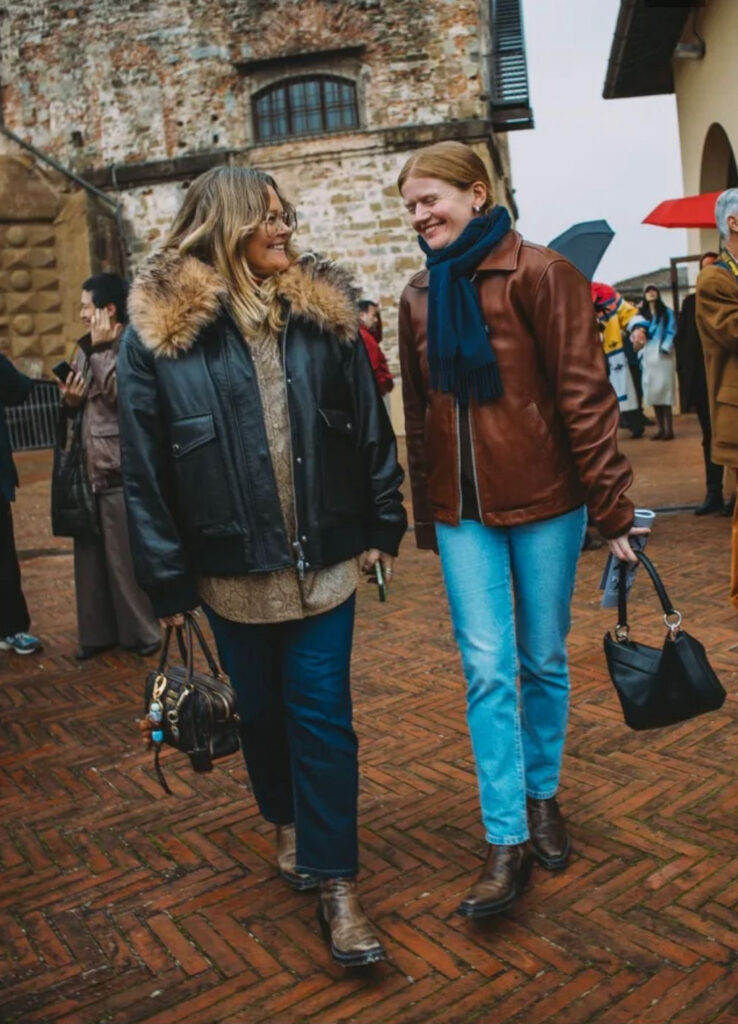
With in-house label Pika Pika, leading distribution company Welcome to Welcome aims to merge Scandinavian minimalism with Mediterranean colours and styles.
How’s the fair for you?
— Overall, it’s been really good, says co-founder Ramzi Larif. What I like the most is that it has changed a bit, making it a good way to show how the stores are actually presenting their brands these days. Back in the days, it was super dressed up, while lately, the whole streety vibe has come in. They’ve kept the old heritage that you also want to have here, to get inspired by how people are dressing, looking, mixing, and matching. That development — to have a good mix — is good for a lot of brands, especially Scandinavian, and it becomes more relevant as a meeting place. We’ve actually even had some women’s buyers wandering around here.
Yesterday, I heard one buyer stating how streetwear is dead. What do you say when you hear such a thing?
— Wow. Almost everything is always coming from a streety culture. First, I think you have to define what streetwear is — what it was 15 years ago is not exactly the same now, but we can still see that the big fashion houses are influenced by skateboarding and that kind of stuff. It should be his opinion, but no, I don’t think streetwear per se is dead, although the way that we’re looking at streetwear has changed.
Being a long-time exhibitor at leading fairs across Europe, how have they changed?
— We don’t write so many orders. Back in the days, visitors came in and could say that they liked it, and write an order. They didn’t ask so much about the brand or where it’s from. Now, they’re more interested in that, and with all the brands that we create ourselves and represent, we do more storytelling. Visitors here are much more interested in how we think with the design, why we’ve done it, how it shall be packed together, and the story behind the brand.
Being the first in the show season, some say that Pitti sets the standard for how the season will be. If Pitti is busy, it will mean a busy season ahead.
— Yes, probably. And I would wish that even more should come. I’m telling all the Scandinavian clients that this is a fair you need to go to and take a look at. Even if you don’t buy or sell suits, you get so inspired coming here, and you have so many good brands, making it a great international fair to go to.

Founding organisation Pitti Immagine also stands behind niche perfume fair Pitti Fragranze in September each year. For Pitti Uomo 109, this was incorporated in the new Hi Beauty! section, showcasing selected names from the world of niche. Among them was Amoln from Sweden, expanding its line of hand creams and scented candles with a debut perfume range in March.
— Today, we are doing very well in multi-brand fashion and lifestyle stores, and we have a lot of nice clientele here with good stores, agents, and distributors, so it’s a very good place to be and launch it, says co-founder Jonas Bergholm.
It’s not a coincidence that Pitti Uomo launches a dedicated area for niche fragrances now.
— No, I believe not. It’s a hype at the moment, which we can see globally as well, and many of our partners are screaming for us to launch the perfume line now and not in March.
Globally, it’s perhaps also much easier to get an end consumer to pay 60, 70 euro for a candle.
— Yes, it’s different purchasing powers in different regions, of course. From the beginning, we don’t target everyone. Our products are a nice-to-have, not a need-to-have. We have fans, people who love scents, which is quite a large market. I see a bright future.
And one of those fans mentioned is the Swedish royal family.
— Yes, we did a collaboration with them a few years back, a candle.
And you’re now available in several of the world’s leading retailers.
— Yes. It’s hard. But it’s also a snowballing effect. Our first-ever customer was Luisa Via Roma. Now, we are with NK in Stockholm, Isetan in Tokyo, Bergdorf Goodman in New York, and opening up in Selfridges now, in January. If you have good stockists, others are coming along. You can leverage different stores to get into new ones, and if you work with very nice partners, agents, and distributors, that also helps a lot!

Lidia Ageeva, Head of Fashion and Beauty at ICON Magazine, also noticed the rise of beauty at Pitti Uomo.
— It’s natural, being one of the categories that keeps growing. In times of crisis, people address beauty products, and they know that it can be pricy, but they don’t judge themselves that much when they buy it. For womenswear, we always say ’the lipstick effect’; when a woman can’t buy a Dior dress, she’ll buy a Dior lipstick instead and feel very happy anyway. For menswear, I feel it’s the same about scents — people are super excited to try everything on — which is why we have more of them this season. Brunello Cuccinelli brought three new, Stefano Ricci has developed special perfumes that they introduced here, and a brand like Marina also has it.
And the margins are so good for fragrance.
— Yes, and even if it’s expensive, say between 200 and 300 euros, people don’t consider it to be so expensive. And, you can have 10 or 20, and nobody will judge you…
What else have you noticed at Pitti?
— I feel like we need to rediscover why we shop, how we shop, and who the customer is. How many clothes do you need? One of the panellists in the Mr Porter seminar that I attended mentioned his granddad, who had his shorts made to measure. I think we’re coming back, in clothing, to made-to-measure.
— Also, with AI, people don’t search words; they search context. It’s a huge trend, and is gonna define the way people look for new brands. It’s kind of cool that the storytelling will prevail.
— I’ve also noticed a new focus on extra luxury. It’s not about just doing a product anymore, rather go an extra mile when introducing new, very exquisite, and developed fabrics. This includes a lot of mouton (’we know it as sherling, but in Italy, they say mouton’) — which is definitely back. Especially now, since fur is banned almost everywhere, while sherling is not. It’s now back as a luxury material, also inside the shoes, to make them super comfortable.
— Also, I loved to see a silk coat at Caruso. Not a silk pyjama, but a real coat with a silk texture, and they said that they’ve developed it for two years.
— All in all, I feel like everybody goes an extra mile to introduce new materials that feel even more luxurious, including mixes of silk, cashmere, and acuna, going into luxury luxury.
You also mentioned how retailers are now looking at fashion and beauty at the same time.
— Yes. Take Colette, where Sarah (Andelman, founder) didn’t have perfumes at first, but introduced them quite quickly, because her PR person was into beauty. Business-wise, it was great for Colette; it was a huge part of their business. So, we’ve already seen it, but perhaps we were not looking into it with such consideration, while now, since we’re in the craziest of times, everybody looks at beauty.
— We also live in very global times. We have a lot of Japanese, Korean, and Scandi designers that come to show at Pitti, and it’s great that we now also have perfumes from all over the world. The perfume business used to be very defined by Grasse and everything in France, so it’s good to have a global perspective. It also used to be a men-dominated business. because women were not considered perfumers, but I feel a change: there are a lot of women perfumers now.
And your overall feelings are positive?
— Yes. The theme of this Pitti is Motion. As long as we’re in motion and don’t stay just being pessimistic and saying that it’s a crisis, but instead try to find solutions, they will come. And so will new upcoming brands, and survive!